


The brief
Tiny Edem is our own strategy game with a simple question at its centre: what if everything you gave was good? Its tagline is "The kindest gift can be the most dangerous." The player is a benevolent deity, and the game is about the second-order effects of generosity. Food today can mean dependence tomorrow. Knowledge without solidarity can widen inequality.
The game needed to be calm, readable on a phone and played in turns, so a player can think before each move. It also had to run as plain files with no account and nothing sent to a server.
What we built
Twenty years, three villages
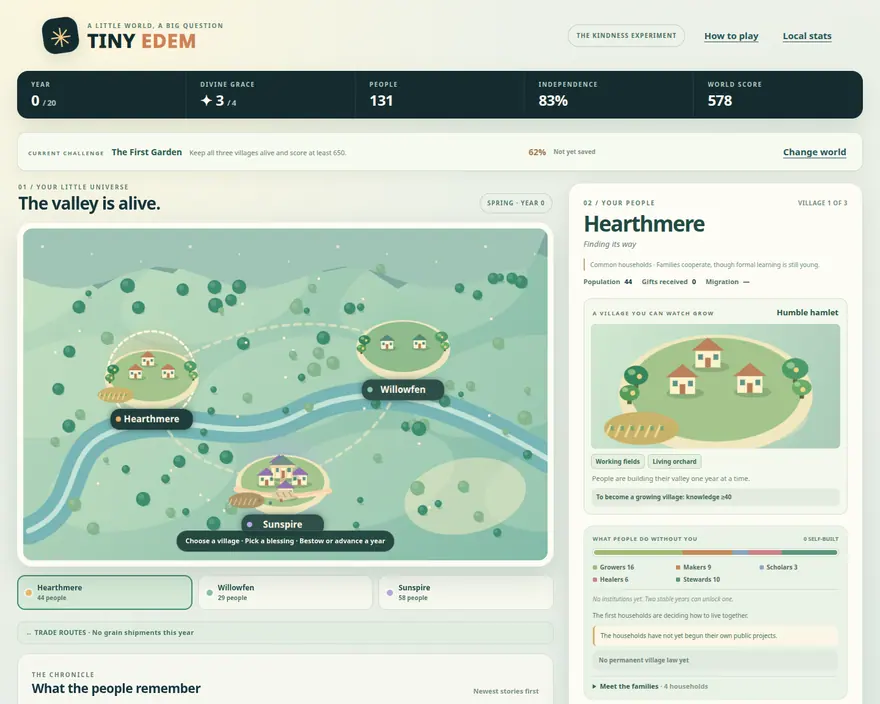
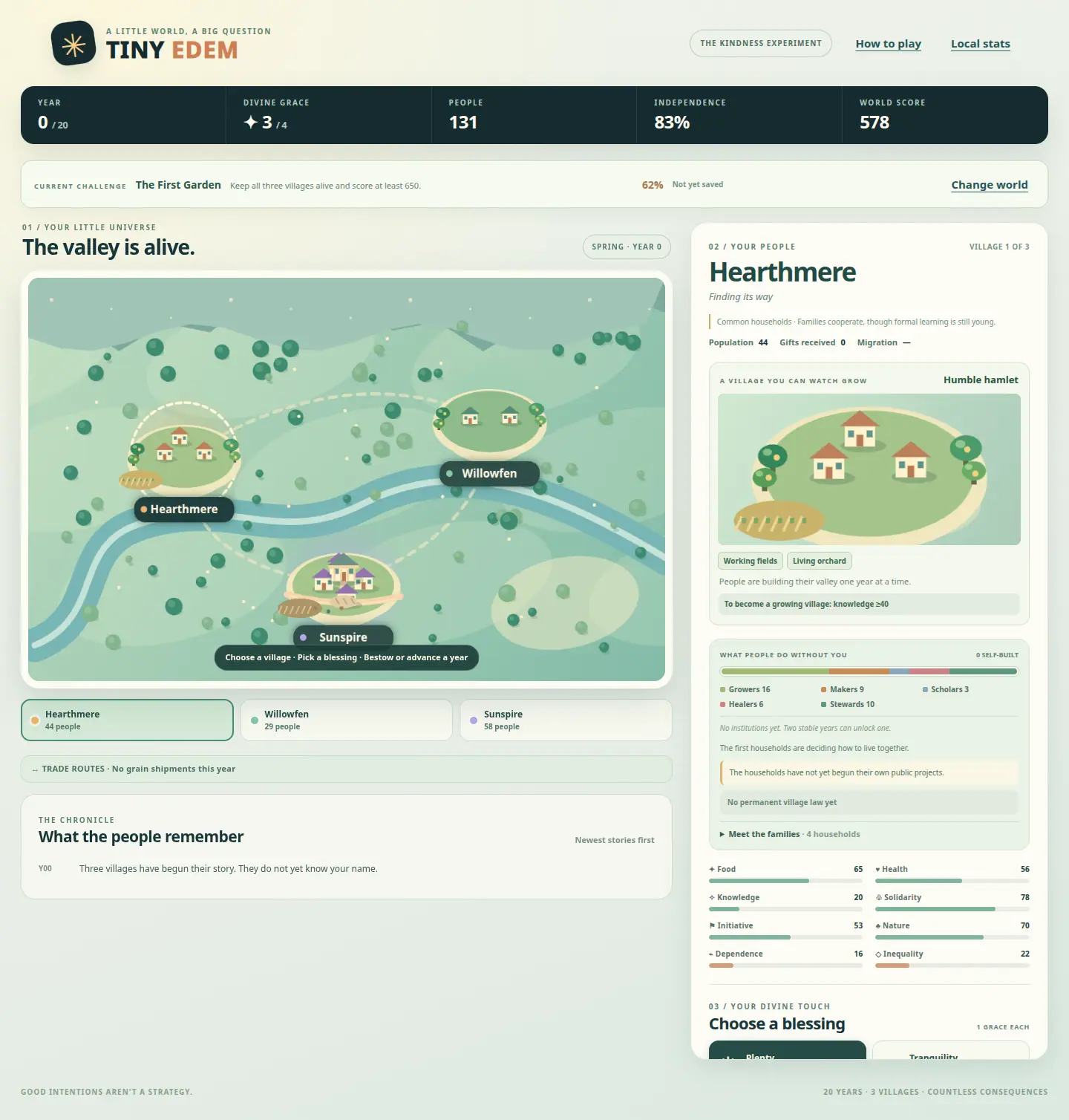
The valley holds three villages: Hearthmere, Willowfen and Sunspire. Each year restores one Grace, up to four, and each blessing costs one. There are seven blessings: Plenty, Tranquility, Insight, Mercy, Rewild, Courage and Fair Share. Every one has a benefit and a cost, and some effects arrive seasons or years later. The player selects a village on the map or in the panel, bestows a gift and advances the year.
At year 17 the divine power falls silent. The last three years must be survived without miracles, and that is where a fragile paradise shows its weak spots.
A society that answers back
Villagers choose their own work, build institutions such as a workshop, an academy, a clinic or a forest guild, and move to better opportunities. Grain travels between villages along visible trade routes. In years 4, 9 and 14 the village council proposes competing laws. The player may recommend one, but the households vote and can reject it.
In years 3, 7, 11 and 15 a household brings a dilemma, such as harvest against wetlands or sheltering refugees against keeping existing stores. Before choosing, the player sees the immediate numbers and the change due three years later. Seeded surprises, such as a frost, a caravan or an old library, add to the story.
A valley you can watch grow
The map is drawn on Canvas from the simulation itself. A hamlet can become a village, a town and a living city, or fall back into ruins. Farms, orchards, groves and real landmarks for each institution appear as they are built. A close-up of the selected village lists what it still needs to reach the next stage.
Scenarios, saves and replays
A game starts with one of three scenarios. At the end, a comparison puts the three villages side by side and labels each by the gifts it actually received. The player can replay the same world with other blessings, enter a seed or start a new one. A five-step guide teaches the first year and can be skipped. Local stats show plays and finishes on that browser only.
Where it stands today
On 8 November 2026 the game is live at tinyedem.mmix.biz in English. It opens on year 0 of 20 with the First Garden challenge, "Keep all three villages alive", and the first step of the guide: "Meet your people". It plays with touch, mouse or keyboard and shows no ads.
Related
How we build web products: web development. Another god game of ours: GLOSS: Little Worlds. A quicker arcade game: Tiny Disaster. A game studio's website we built: Everest Games.
Project lead: Marketing MIX. Product: Tiny Edem, our own browser game. Year: 2026.