

The brief
Tiny Disaster is our own arcade game, and its tagline is the whole pitch: "Small storm. Big problems." The player is a tornado the size of a coffee cup. Each run lasts 100 seconds. In that time the storm swallows small things, grows, and works its way up to buildings.
The game had to make sense within the first seconds on any screen and give players a reason to start another run. It also had to stay light: plain files, no installation, no account, and nothing loaded from other servers.
What we built
A storm that grows
The storm moves with WASD or the arrow keys on a computer and with a thumb joystick on a phone. Small objects feed it. As it levels up, larger props become breakable. Props within reach spiral into the funnel before they disappear, and each hit leaves a short impact ring. Destruction in quick succession builds a combo, with a meter that shows how long the multiplier lasts.
Smashing things charges the Chaos Engine. When it is full, Space or the BLAST button fires the Chaos Blast: for a short time the storm breaks bigger objects and reaches further.
Reasons to play one more run
City Dispatch gives five missions in a row, each asking for a certain kind of object. The first one, Street Cleanup, asks for eight. Each cleared dispatch adds bonus points and extra seconds. A compass points to the next target.
At levels 2 and 4 the run pauses and the player picks one of three mutations: Turbo Wind, Big Mouth or Hungry Storm first, then Quick Charge, Chaos Math or Second Wind. The timer stops while the player chooses. Three blue storm fronts also cross the map during a run. Catching one starts a nine-second Frenzy.
Daily Disaster builds one map per day from the date, and the Storm Passport collects nine stamps for things like finishing a daily run or reaching level 6. Best scores and stamps are saved in the browser only.
Built light
The game is written in plain JavaScript modules with Canvas 2D and CSS. It loads no external fonts, images, SDKs or analytics. The neighborhood is generated procedurally from about 640 objects. A spatial index lets the game check only the nearby objects each frame, and on phones the drawing resolution is capped so older devices keep up.
At the end of a run, COPY PLAYTEST REPORT puts a short text summary on the clipboard: timings, score, dispatches, mutations and input type. It is never uploaded.
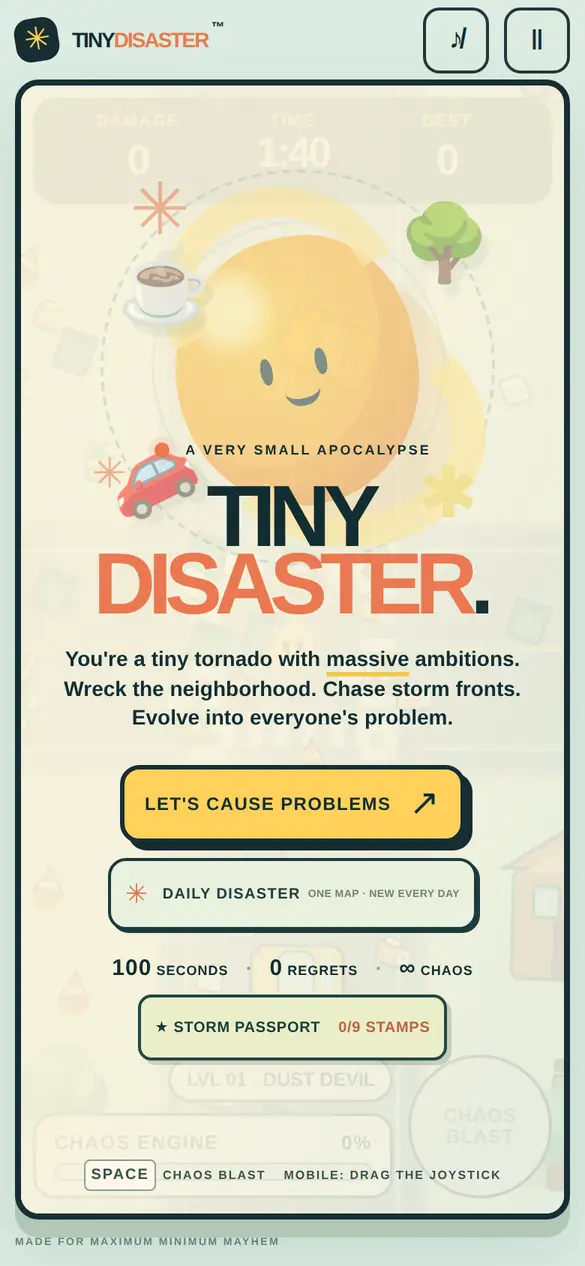
A phone pass on 6 November 2026 hid the small HUD captions in portrait so the big numbers read at a glance, and enlarged the sound, pause and Storm Passport buttons to 44 pixels.
Where it stands today
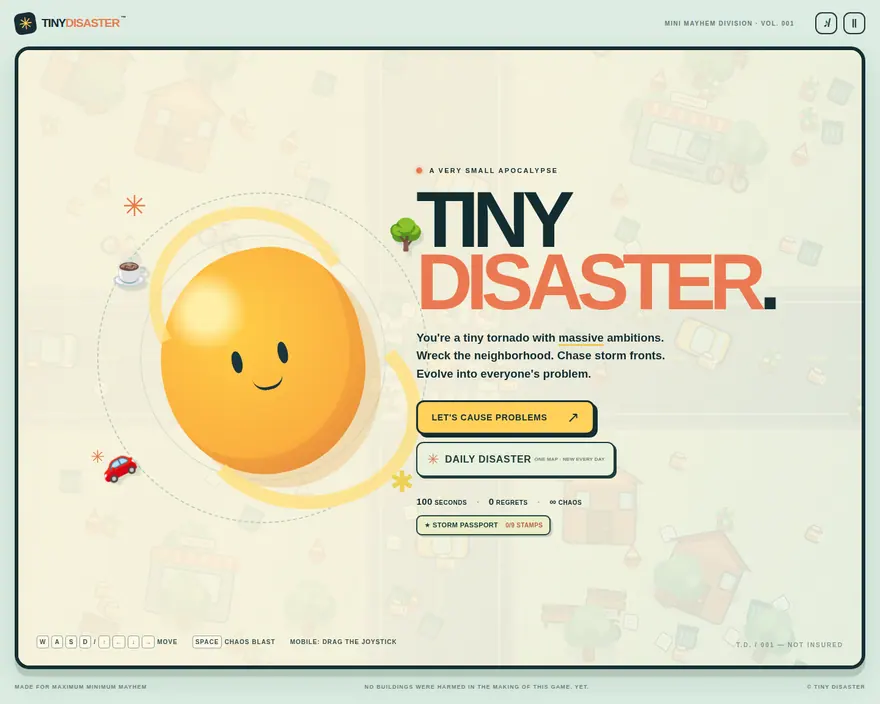
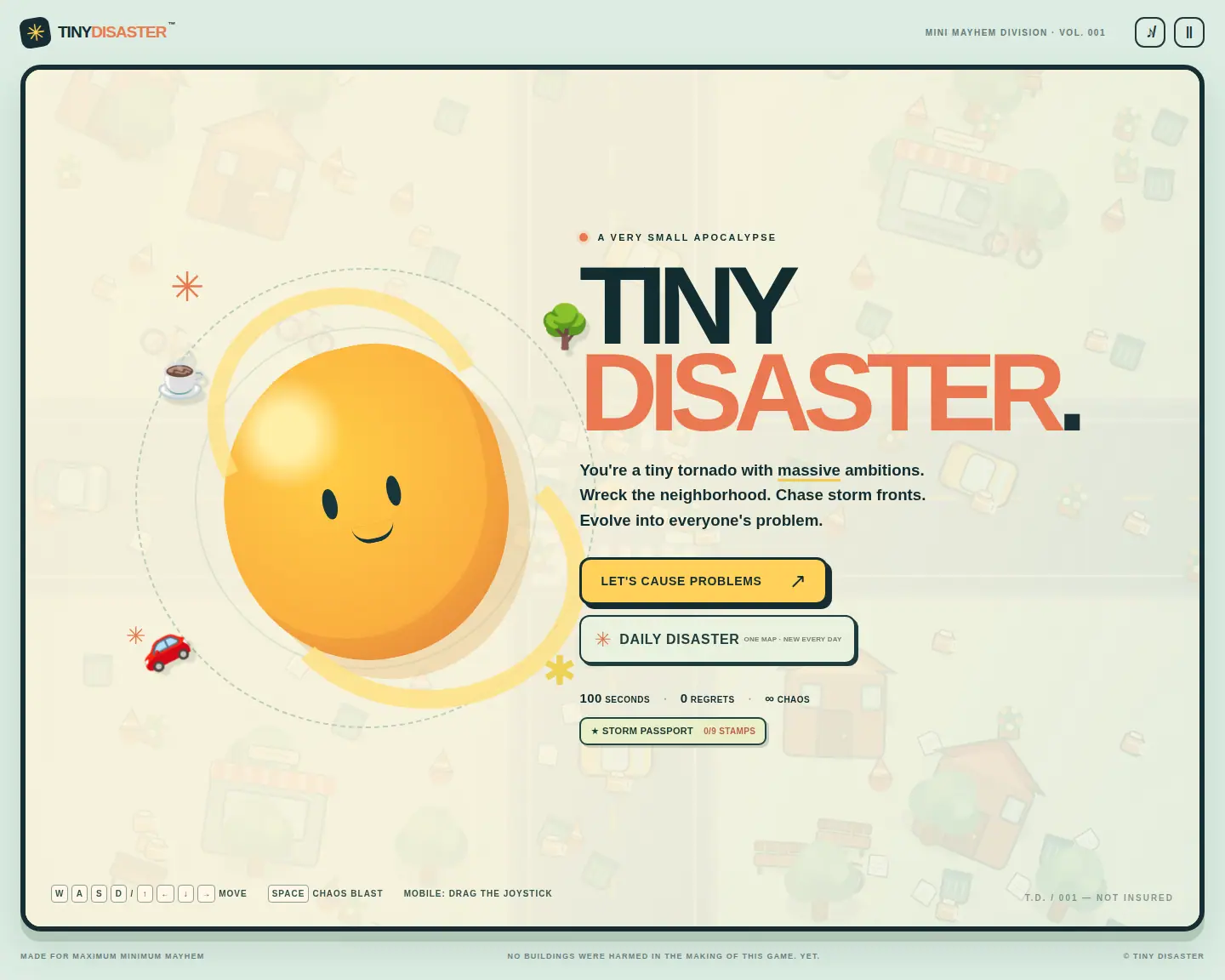
On 8 November 2026 the game is live at tinydisaster.mmix.biz in English. The title screen reads "A very small apocalypse" and offers two modes: free play with LET'S CAUSE PROBLEMS and DAILY DISASTER. Controls are shown on the start screen for both keyboard and touch.
Related
How we build web products: web development. Another arcade game of ours: Order Riot!. A stealth game in the same series of small browser games: Tiny Heist. A game studio's website we built: Everest Games.
Project lead: Marketing MIX. Product: Tiny Disaster, our own browser game. Year: 2026.