


The brief
RedactGate is a product of the business group Marketing MIX belongs to, so this case describes our own work. It answers a problem the landing page puts first: at accounting and law firms, staff already paste client documents into chat assistants to get a summary, because they have no safe alternative. A bank statement or a contract with names and account numbers leaves the firm, and the compliance officer cannot prove what was sent.
The brief: let people keep using any cloud model, keep the raw client record inside the firm's perimeter, keep the answer just as useful, and log every request for an audit.
What we built
The gateway
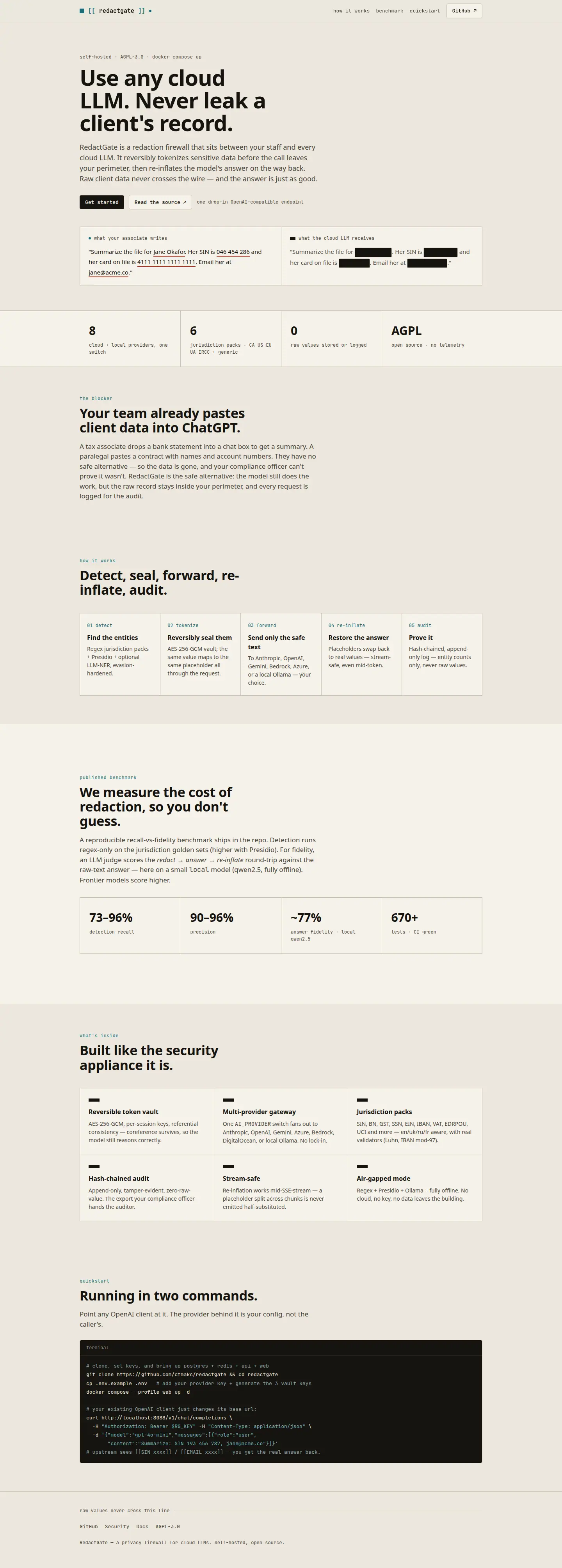
Work on RedactGate started on 19 June 2026; the last commit before this case is dated 6 November 2026. It is a self-hosted service with an OpenAI-compatible endpoint, so an existing client only changes its base URL. A request passes five steps. Detect: rule-based jurisdiction packs and a named-entity recogniser find the sensitive values, with an optional model-based pass. Seal: each value is replaced with a placeholder and stored in an AES-256-GCM vault, and the same value gets the same placeholder throughout the request, so the model can still reason about who is who. Forward: only the sealed text goes to the provider. Restore: placeholders in the answer are swapped back for the real values, also while the answer is streaming, so a placeholder split between two chunks never reaches the user half-replaced. Audit: an append-only, hash-chained log records entity counts and never the values.
The gateway can forward to eight cloud and local providers, switched by configuration. A policy engine decides per team and route whether a value is tokenised, masked or blocked outright, and which providers are allowed. In air-gapped mode detection and the model both run locally, and nothing leaves the building.
Jurisdiction packs
Detection comes in packs for Canada, the United States, the European Union and Ukraine, a pack for Canadian immigration client numbers, and a generic one. They cover numbers such as the SIN, business and GST numbers, SSN and EIN, IBAN and VAT numbers and the Ukrainian EDRPOU code, with real check-digit validators (Luhn, IBAN mod-97). They understand English, Ukrainian, Russian and French text.
Measured, in the open
The landing page publishes what redaction costs in answer quality. A benchmark that ships with the code reports detection recall of 73 to 96% and precision of 90 to 96% on the jurisdiction test sets with the rule-based detector alone, and about 77% answer fidelity when a small local model answers the redacted question and a judge compares the result with the answer to the raw text. More than 670 tests run in CI.
The landing page
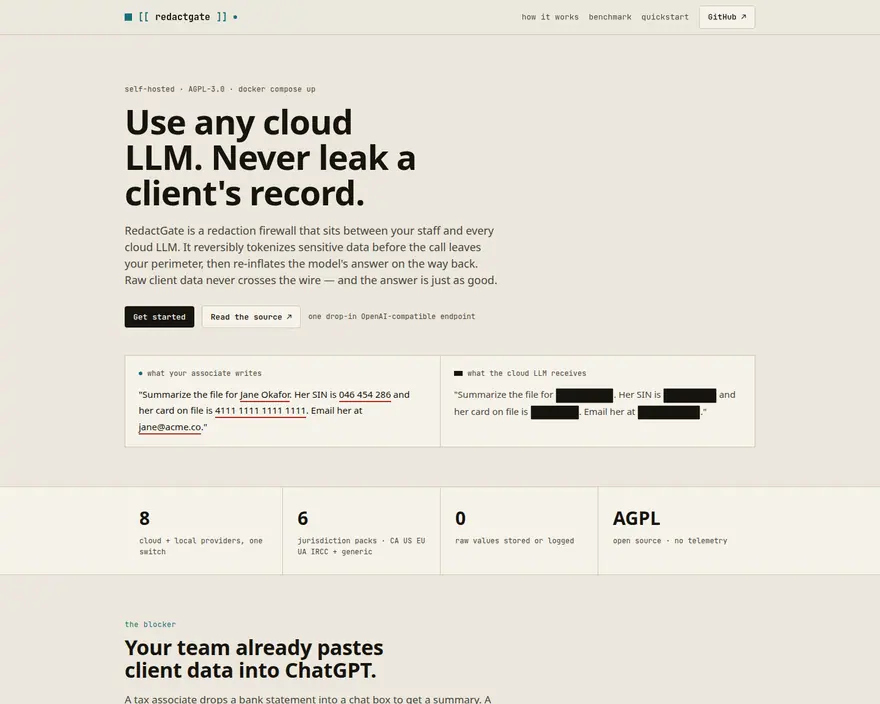
redactgate.pages.dev is a single static page. It opens with a before-and-after example: what an associate types, with a name, a SIN, a card number and an e-mail, and what the cloud model actually receives, with placeholders in their place. Then come the problem, the five steps, the benchmark, what is inside, and a two-command quick start with Docker Compose.
Where it stands today
On 8 November 2026 redactgate.pages.dev is live in English. The page presents RedactGate as a self-hosted, open-source product under AGPL-3.0, with links to the source code, the security policy and the documentation.
Related
Security work: cybersecurity. The product page: landing page development. Another product of our group: IXIA. The sector: fintech and accounting.
Project lead: Marketing MIX. Product: RedactGate, the LLM privacy gateway of our business group. Year: 2026.