

The brief
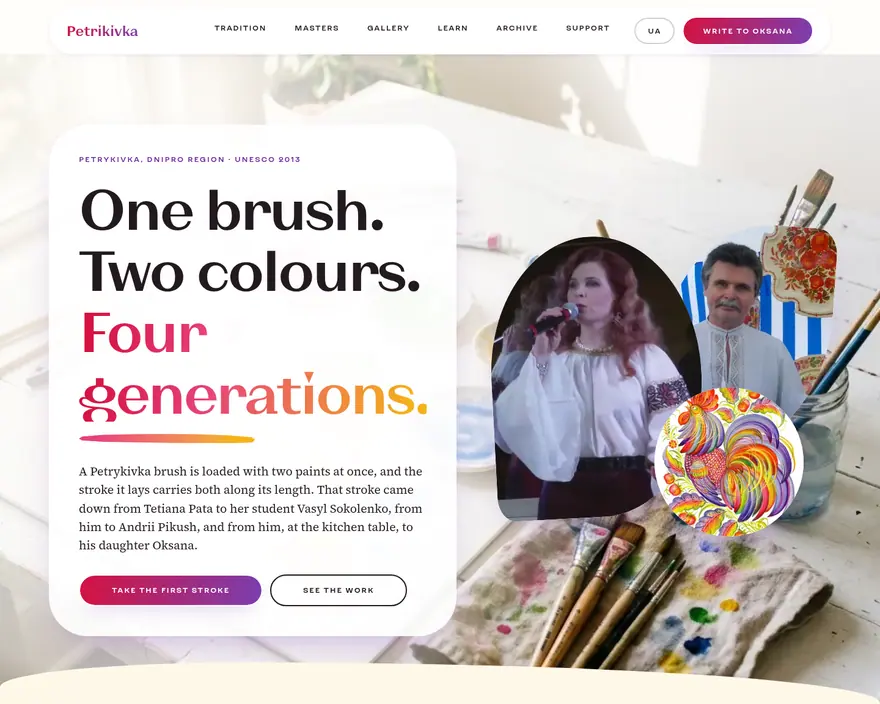
Petrykivka decorative painting comes from the village of Petrykivka in the Dnipro region of Ukraine. UNESCO inscribed it in December 2013 as Ukraine's first element on the Representative List of the Intangible Cultural Heritage of Humanity. Its signature is the transition stroke: one brush loaded with two paints, so a petal turns from carmine to ochre inside a single mark, painted straight onto the surface with no drawing underneath.
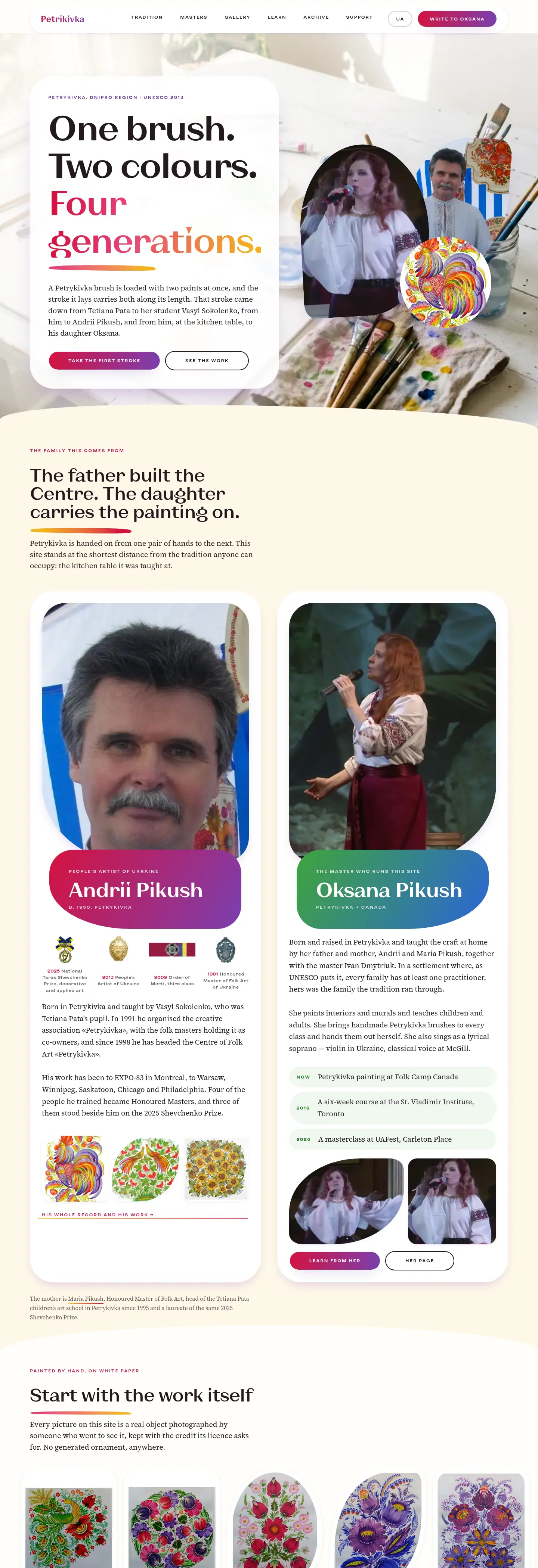
Oksana Pikush was born in Petrykivka and taught the painting at home by her parents. Her father, Andrii Pikush, is a People's Artist of Ukraine who has headed the Centre of Folk Art "Petrykivka" since 1998. Her mother, Maria Pikush, an Honoured Master of Folk Art, has headed the Tetiana Pata children's art school in Petrykivka since 1995. Both are laureates of the 2025 National Shevchenko Prize. Oksana now lives in Canada, where she paints murals and interiors and teaches. In 2026 she gave a masterclass at UAFest in Carleton Place, Ontario, and the site started there.
The brief: a site that explains the tradition with care, shows the line of masters it came down through, and lets people learn from Oksana, commission her work and support the recording of the older masters.
What we built
Seven sections around one tradition
petrikivka.com is a Next.js site in English, with a Ukrainian version under /uk. The menu holds Tradition, Masters, Gallery, Learn, Archive and Support, with Commission, Journal and About in the footer. Tradition explains the painting and keeps a glossary of every named stroke and element in Ukrainian and English. Masters follows the line of transmission from Tetiana Pata to her student Vasyl Sokolenko, from him to Andrii and Maria Pikush, and on to Oksana, with their records and work. The Living Archive, at its start, sets out how to record the masters taught by Pata's own students while they can still teach. Support says what money would pay for, and Commission covers walls, objects and what a brand may do with a painted pattern.
A real first lesson
Learn opens with a free lesson on the zerniatko, the little grain: the first stroke a student in Petrykivka is given, which needs only a brush, a saucer of paint and a sheet of paper. It lists what goes wrong, practice sheets, honest substitutes for the traditional tools and what a beginner does in sequence, then leads to classes with Oksana.
Sources and credits as a rule
The site works by an editorial rule: every factual claim carries a source, and where sources disagree the page says so. The gallery holds 39 real works from open-licensed collections, each with its author and licence. Ukrainian spellings and Ukrainian name order are kept throughout.
A look taken from the brush
The design has two grounds, lacquer black and unbleached paper, and one signature: the transition stroke, used as the only divider, underline and indicator. Headings are set in Kyiv Type Sans and text in Source Serif 4. One form, Write to Oksana, takes messages about lessons, commissions, support and press, and a mailing list sends news only when a master's page, a recording or a class is published.
Where it stands today
On 8 November 2026 petrikivka.com is live in English and Ukrainian, with 40 addresses in its sitemap. The footer reads "Born at UAFest 2026, Ukrainian Fest, Lanark County, Canada" and carries the Development and promotion credit. Our work on the site runs from 15 September to early November 2026.
Related
The site: corporate websites and educational websites. Where the site started: UAFest 2026. Another heritage project with a source on every claim: BABA & KOKUM.
Project lead: Marketing MIX. Client: Oksana Pikush, Petrykivka painter (petrikivka.com). Year: 2026.