


The brief
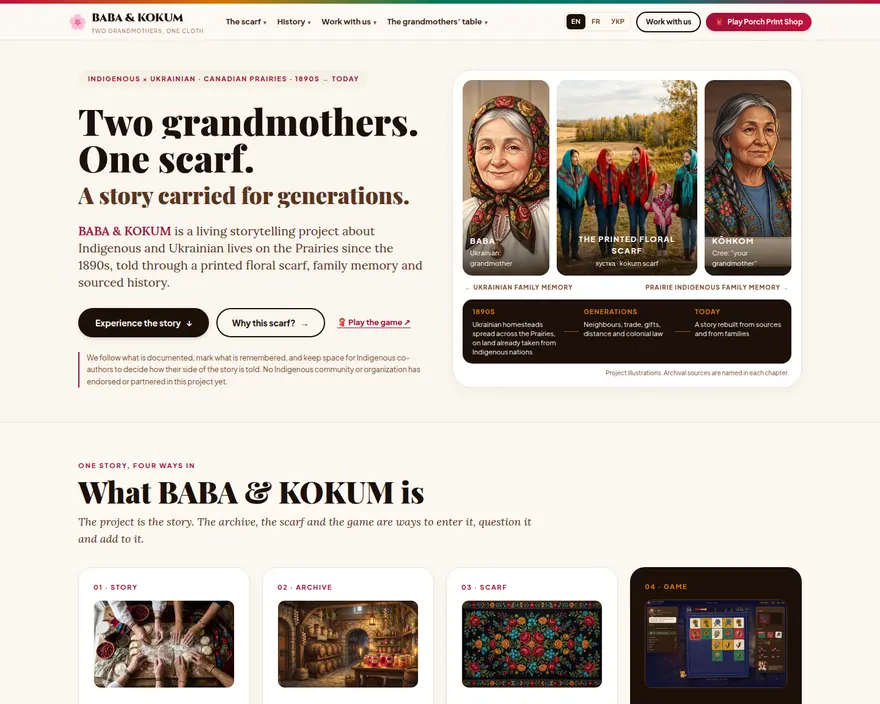
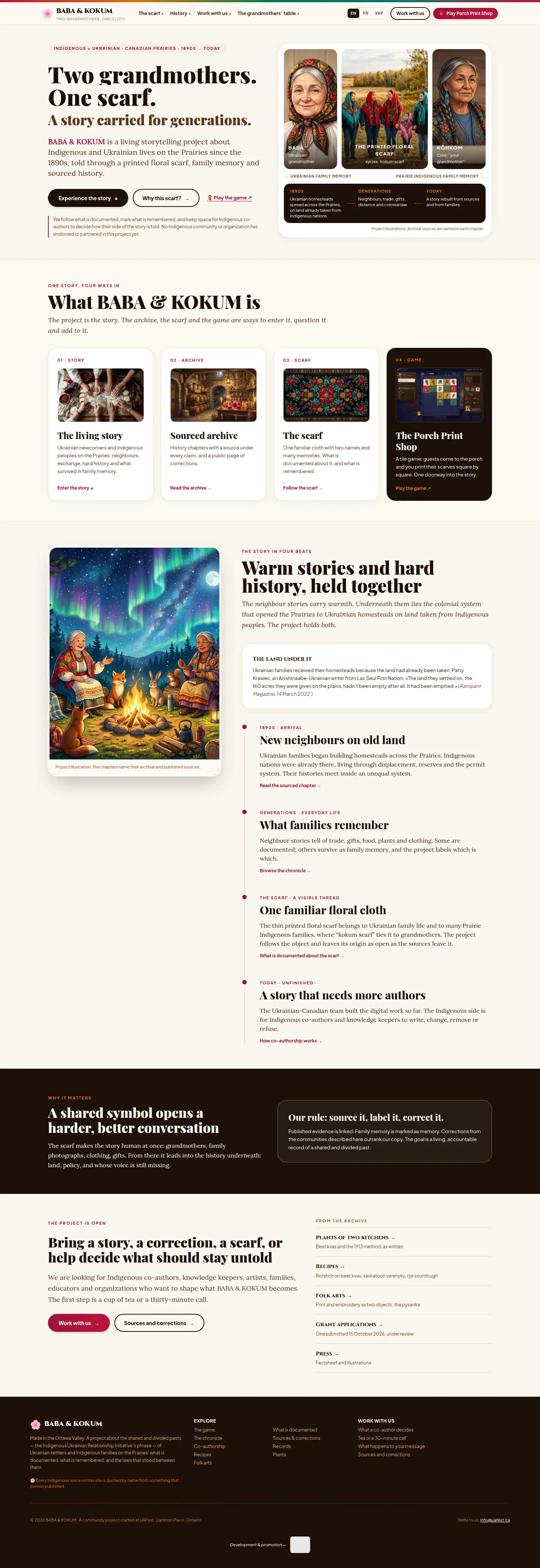
BABA & KOKUM is a community project about the shared and divided pasts of Ukrainian settlers and Indigenous families on the Canadian Prairies, from the first homesteads of the 1890s to today. Its common thread is one object: the printed floral scarf, the khustka in Ukrainian families and the kokum scarf in Prairie Indigenous ones. The name pairs BABA, Ukrainian for grandmother, with KÔHKOM, Cree for "your grandmother". The project started at UAFest in Carleton Place, Ontario, and was first shown there in September 2026.
A history that touches two peoples and a painful period needs a strict rule about evidence. The brief was a site that tells the story warmly, keeps every claim tied to a published source, leaves room for Indigenous co-authors to decide how their side is told, and gives younger visitors a way in through play.
What we built
A generated site in three languages
babakokum.com is a static site generated by a Python build script in English, French and Ukrainian. Pages are never edited by hand: texts for all three languages live in the build scripts, and the build writes every page, the sitemap and the cross-language links. The menu has four doors: The scarf, History, Work with us and The grandmothers' table.
The source rule, enforced by the build
The project's founding document sets three rules. A claim with no published source is cut. About Indigenous peoples, the site publishes only what Indigenous people have published themselves. Nobody is named as a partner before they agree in writing. The build enforces the first rule mechanically: claims the project has withdrawn are kept in a list, and if one of those phrasings comes back into a page, the build fails. A public page, Sources and what we know, lists the sources and everything the project withdrew. The home page states that no Indigenous community or organization has endorsed or partnered in the project yet.
History, kitchens and records
The Chronicle runs from 1891 to 2026 in four eras: the burdei dugouts of the first winters at Edna-Star, the kokum scarf, neighbours and the law, and the scarf's return from 2018. The grandmothers' table holds recipes written out in full (borshch on beet kvas after a 1913 method, saskatoon varenyky, rye sourdough), the plants of the two kitchens and folk arts, with print and embroidery treated as two different objects. Work with us explains co-authorship and what a co-author decides, and links a press factsheet and classroom drafts for grades 6 to 12, marked as awaiting review. A partner form in all three languages sends each message to the team.
The Porch Print Shop
The browser game at scarf.babakokum.com turns the scarf into play. Guests arrive at the porch and ask for a scarf, and the player prints it square by square: each tile is a motif in a colour, scored for patches, bunches, mirroring and the border, on a board that grows from 3 by 3 to 5 by 5. It runs in English and Ukrainian, on phones and computers, installs like an app and keeps working offline. The site's Play button opens it from every page.
Where it stands today
On 8 November 2026 babakokum.com is live in English, French and Ukrainian with 45 addresses in its sitemap, and the game answers at scarf.babakokum.com. The footer reads "A community project started at UAFest, Carleton Place, Ontario" and carries the Development and promotion credit. The repository history runs from 20 August to 8 November 2026.
Related
The site: corporate websites and educational websites. The festival where it started: UAFest 2026. Another heritage project with a source on every claim: Petrikivka.
Project lead: Marketing MIX. Product: BABA & KOKUM, a community story project with its game The Porch Print Shop. Year: 2026.