


The brief
Maksym Stepanenko, the founder of Marketing MIX, publishes short and long videos on YouTube: international companies and tax, partnerships and contracts, second citizenship, AI in business, life in Canada, and the projects of the group, such as UAFest. By autumn 2026 the main channel had well over a hundred videos. Each one held useful speech that search engines and AI assistants could hardly read, because a YouTube page carries little text beyond the title and description.
The brief was a site that lays every video out as a page of text: what it is about, the key moments, and the full speech with time codes. A reader should be able to find a phrase, quote it and jump to the exact second in the video. Views should still count for the channel.
What we built
An index of speech
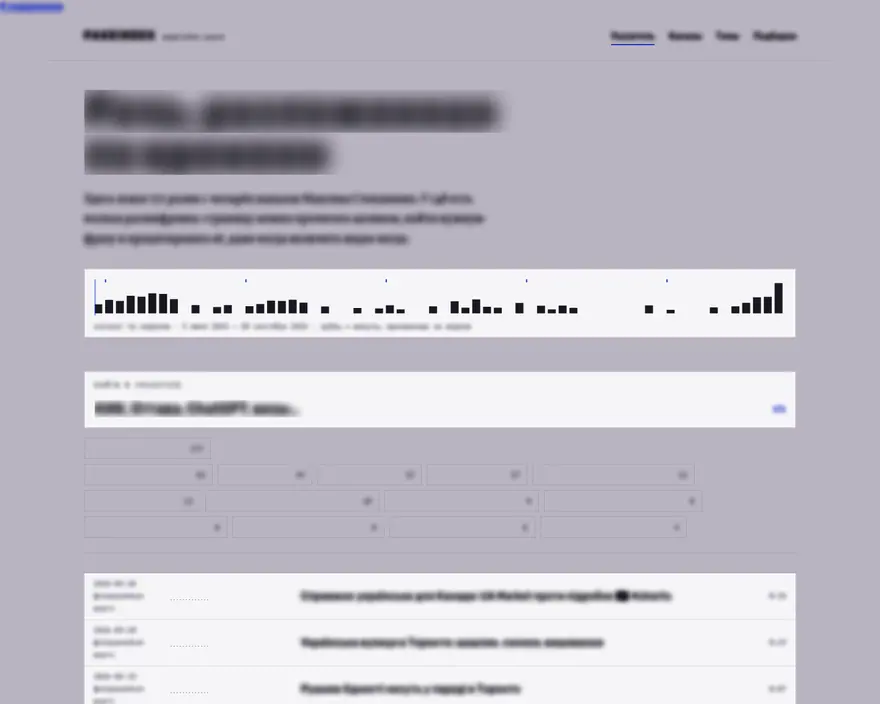
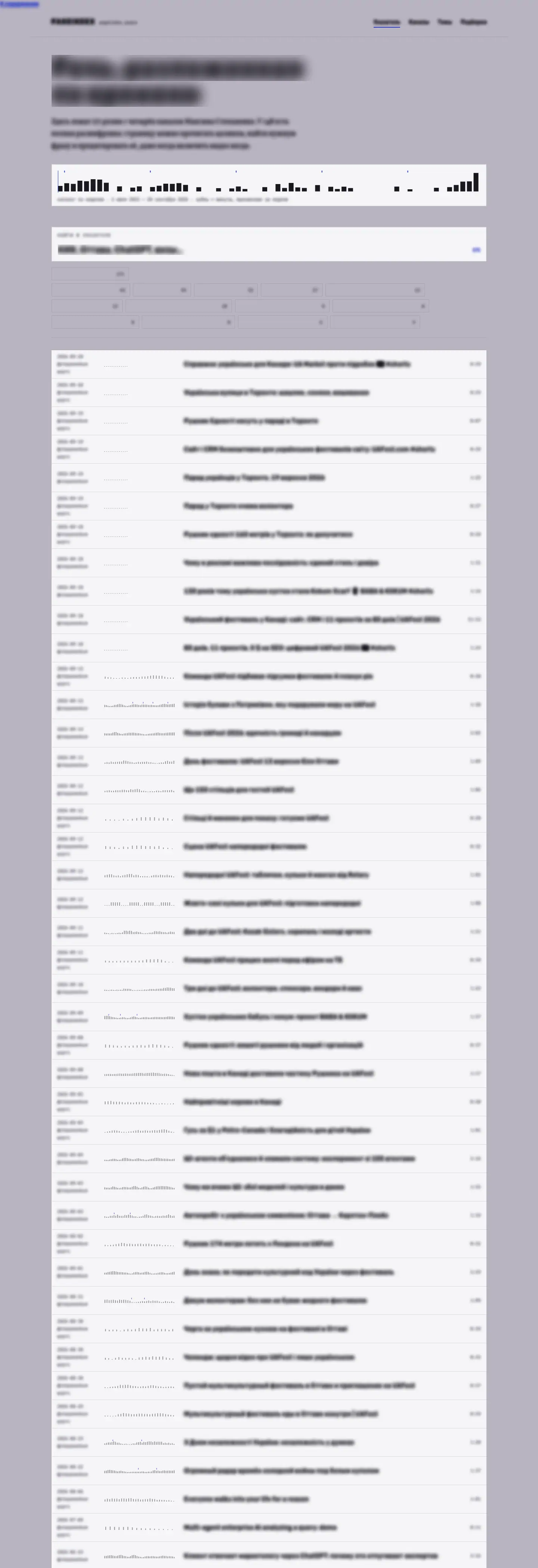
The home page is an index. Its headline reads "Speech laid out in time". Every video is one line: date, channel, title and length, with a filter by channel and by topic and a search box. On 8 November 2026 the index holds 171 videos, 148 of them with a full transcript, from 5 July 2025 to 20 September 2026. The 13 topics include law, tax and business; blog and projects; Canada and travel; AI and technology; companies abroad and tax; and partners, shares and contracts. The sections in the header are Index, Channels, Topics and Collections.
A page for every video
Each video has its own address under /v/. The page opens with what the video is about, then the key moments, each of which opens the video on YouTube at its second. Below come the author's description, the full transcript with a time code in the margin for every passage, the embedded YouTube player, a "Watch on YouTube" link and related videos on the same topic. Where a topic matches a service, a short block names the team that does this work, such as Legal Solutions for questions on shares and partnership agreements.
The comb
The design direction is called GREBYONKA, the comb. A strip of thin vertical teeth shows how dense the speech is in every ten seconds of a video, counted from the transcript. On the home page the same comb shows how many minutes were published each week. The rule is strict: a comb is drawn only from real data, and a video without a transcript gets an empty strip with a note saying so. Speech is set in a serif, Vollkorn, like the text of a publication; time codes, counters and dates use a monospaced face with tabular figures. The one looping motion is a playhead line that runs across the first comb; under reduced-motion settings it stays at zero.
Collections and markup
A Collections section holds themed lists of checked pages from other sites. The first one gathers 31 links on how to get a DUNS number. The site is static, rebuilt by a Python script from the video data. The home page is described as a CollectionPage with an ItemList, video pages carry breadcrumbs, and the sitemap lists 188 addresses: the index, the channel page, 13 topics, 171 videos and the collections.
Where it stands today
pageindex.space went live on 20 September 2026. On 8 November 2026 the footer says the index was last rebuilt on 7 November 2026. It shows 171 videos and 148 transcripts in Russian, Ukrainian and English as spoken, under a Russian interface, and links to Marketing MIX for website development and promotion.
Related
Search: SEO. Visibility in AI answers: LLM SEO and GEO. The author's site: maxstepanenko.com. A project covered in many of the videos: UAFest 2026 platform.
Project lead: Marketing MIX. Product: PAGEINDEX, the video index of our founder's channels. Year: 2026.