


The brief
Muginai is the SEO platform of the business group Marketing MIX belongs to, so this case describes work on our own product. The studio runs search work on many sites at once, and the routine part of it repeats on every one: collect queries, group them, decide which page answers which group, write a brief, then watch positions and broken pages week after week. Muginai was started to do that routine as a pipeline, with a person approving the decisions that matter.
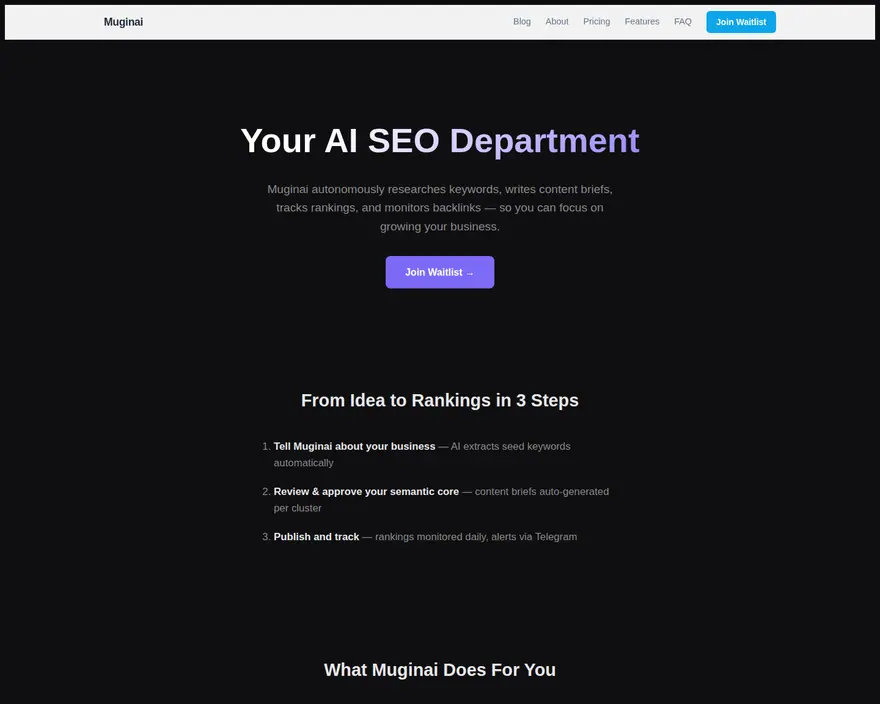
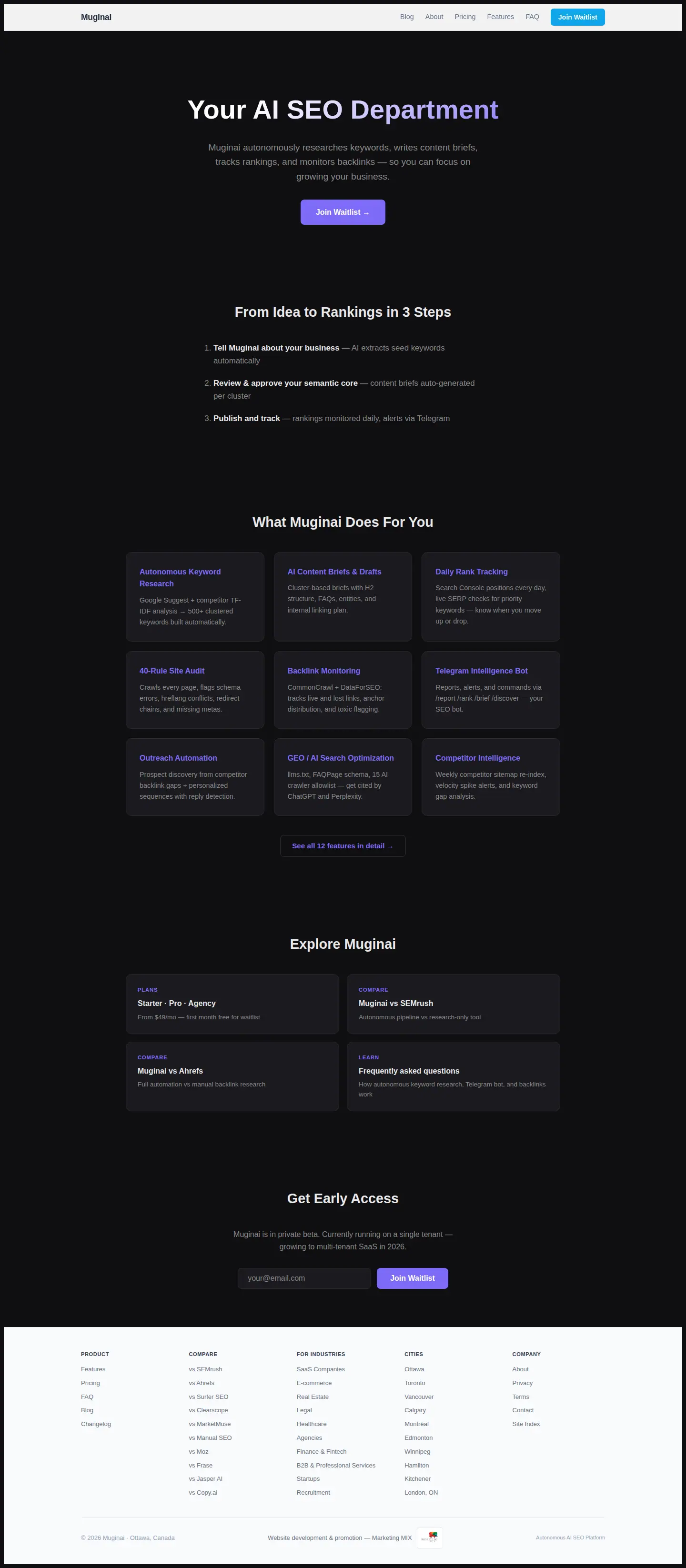
The public site promises the same thing to outside users in plain words: "Your AI SEO department". A business owner describes the business, approves the semantic core the platform proposes, publishes, and then follows rankings and alerts in Telegram.
What we built
The platform
Work on the codebase started on 6 May 2026, and the last commit before this case is dated 8 November 2026. The repository holds an API service, an operator panel built on Next.js, an orchestrator that runs jobs on a schedule, chat bots and the code of the public site, with shared packages for the database, the crawler, data connectors, SEO rules and content. Data lives in PostgreSQL with Redis for queues. Production runs in Docker Compose behind a Cloudflare tunnel, so the server has no open ports.
The flow the site describes has three steps. Muginai extracts seed keywords from a description of the business. The user reviews and approves the semantic core, and a brief is generated per cluster with an H2 structure, questions for an FAQ, entities and an internal linking plan. After publishing, rankings are read from Search Console every day, with live result-page checks for priority keywords.
Around that flow sit the other features listed on the home page: a site audit with 40 rules (schema errors, hreflang conflicts, redirect chains, missing meta tags), backlink monitoring with live and lost links, a Telegram bot with /report, /rank, /brief and /discover commands, outreach prospecting from competitors' backlink gaps, competitor tracking, and optimisation for AI search: llms.txt, FAQPage markup and an allowlist for AI crawlers.
The engine underneath
The platform reads search and analytics data through its own command-line engine, documented in Russian at docs.muginai.com. The documentation lists more than 80 commands for Search Console, Google Analytics 4, PageSpeed, Bing Webmaster Tools and Yandex Webmaster and Metrica, all with JSON output so that agents and scripts can call them. A separate command runs fast indexing through IndexNow, WebSub, Bing, Yandex and a sitemap submission in one pass, and keeps a log of what was submitted and when it was indexed. One section of the page lists the things no tool can do because the APIs do not exist, so nobody waits for them.
The public site
muginai.com is written for people who compare SEO tools before they try one. Next to Features, Pricing, Blog, Changelog and FAQ, it carries comparison pages against ten other tools and approaches, ten industry pages (SaaS, e-commerce, real estate, legal, healthcare, agencies, fintech, professional services, startups, recruitment) and ten Canadian city pages from Ottawa to London, Ontario. On 8 November 2026 its sitemap lists 393 addresses. A consent banner lets the visitor accept or decline analytics cookies.
Where it stands today
On 8 November 2026 muginai.com is live in English with a waitlist for a private beta and three plans named Starter, Pro and Agency. The site states that the product runs on a single tenant today and will open to more tenants later. docs.muginai.com documents the engine. The footer reads "© 2026 Muginai · Ottawa, Canada" and credits Marketing MIX for development and promotion.
Related
Search work: SEO. Visibility in AI answers: LLM SEO and GEO. The sector: B2B SaaS. Another product of our group: CRMiUS.
Project lead: Marketing MIX. Product: Muginai, the SEO platform of our business group. Year: 2026.