
The brief
HATCHWIRE is a game Marketing MIX made for itself, so this case is about our own product. It was built on 3 November 2026. The studio's earlier tap games for young children were too simple for teenagers, so the next game needed a character the player cares about and a reason to come back tomorrow.
We studied what keeps players in the collectible merge battlers on web game portals and took only the genre mechanics: hatching as a moment of suspense, merging two equal creatures into a stronger one, short fights with a visible edge, and the next reward always in sight. Everything else is our own. The audience is players aged about 10 to 18, on a phone or a computer.
What we built
Eggs, genes and fusion
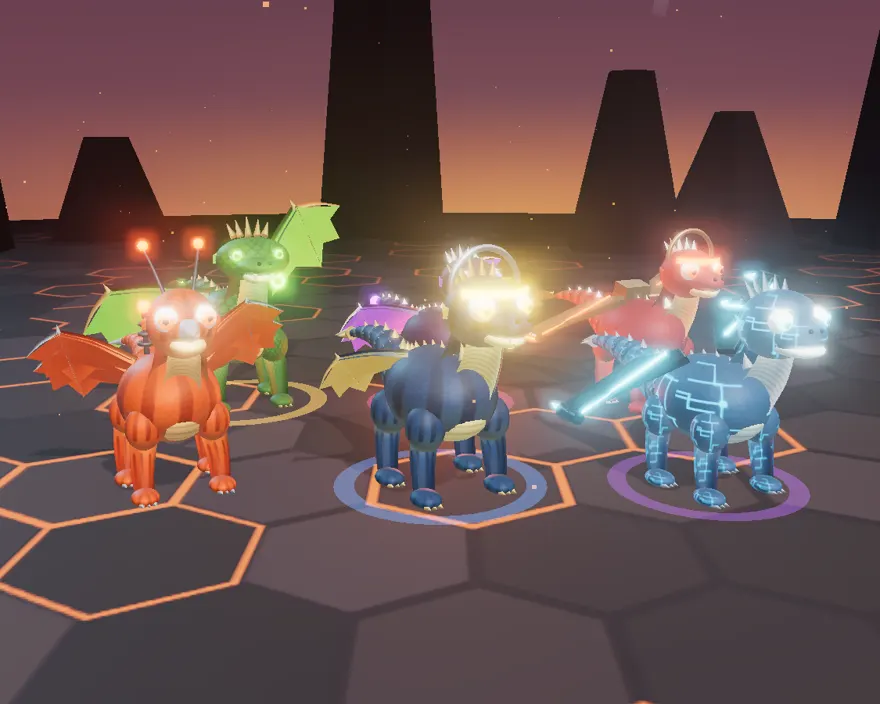
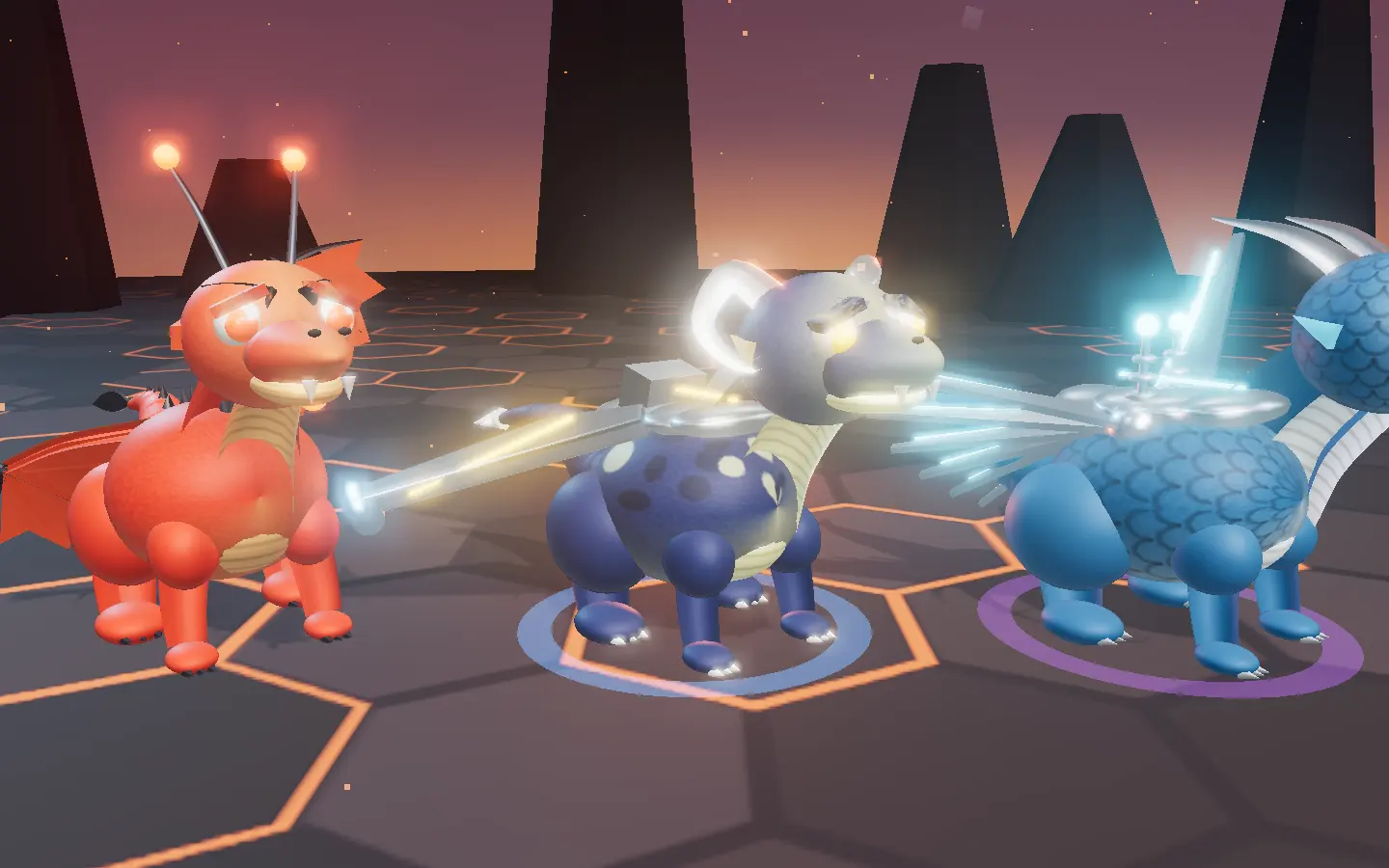
The loop starts with a techno egg. Taps warm it, cracks glow in the colour of its element, and a dragon hatches. Each dragon is assembled in code from eight genes (head, horns, wings, tail, armour, tech module, pattern and eyes), with one of five elements (fire, shock, ice, poison and void) and a rarity from common to mythic. The player picks a team of three for the arena. Two dragons of the same rarity can be fused into an egg of the next rarity that carries genes of both parents plus a mutation. A collection screen, the Dragodex, records the parts found so far and pays a reward for every six.
Fights with a timing bar
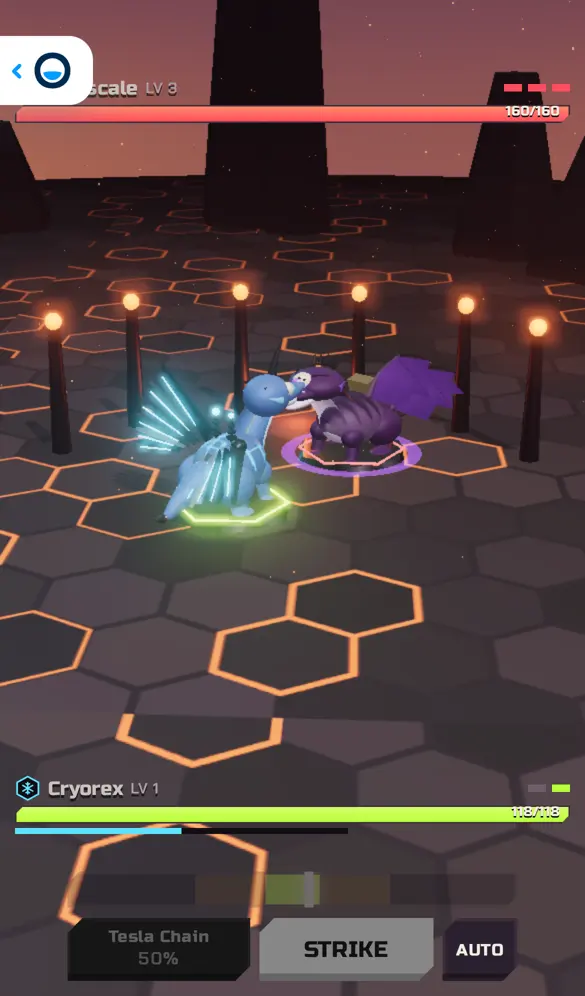
Battles are turn-based. On the player's turn a needle sweeps a bar, and a tap in the green zone lands a PERFECT hit. The tech module charges a skill over the fight: a beam, a shield drone, chain lightning with a stun, missiles or a repair. Elements beat each other in a circle. The arena is a ladder of stages with a boss on every fifth and leagues above, and wins pay coins, eggs and experience. The difficulty curve was set by a balance simulation run over the stages.
The look: a forge in basalt
We considered three directions and chose the third: a lair in volcanic basalt lit from below by molten copper. The dragons combine living scales, steel plates and glowing element modules. Light comes from the elements, and the bloom effect is limited to the parts that emit it. The interface uses Russo One and Chakra Petch, one bright green main button per screen and buttons with cut corners. Movement is heavy on purpose: a short hit-stop, camera shake, squash on landing and wing beats with a phase of their own for every dragon.
First play without text
The first session is taught by a hand that points where to tap, with no written instructions. A test bot taps only where the hand points and has to complete the opening this way. After the first review the camera moved back and the interface became more compact on screens up to 520 pixels wide. Sound and music are synthesised in code, and hits got recoil and audio punch. Saves stay in the browser.
The build carries hooks for a web game portal: gameplay start and stop events, an ad break before fights from the second one on, and an optional rewarded break that doubles coins or hatches an egg at once. Sound mutes during an ad. A 30-second phone gameplay clip was cut from automated play.
Where it stands today
On 8 November 2026 HATCHWIRE runs at hatchwire.pages.dev in English. The opening screen shows coins, eggs and the stage number, the egg in the centre with the pointing hand, an egg tray with a free egg on a timer, and the bottom menu: Lair, Dragons, Fight, Fuse and Dex.
Related
Web builds: corporate websites. Our other browser games: TOPPLE, a domino roguelike and Raccoon Pentathlon.
Project lead: Marketing MIX. Product: HATCHWIRE, a browser game of our studio. Year: 2026.