

The brief
Game facilitation is practiced every day in classrooms, boardrooms, therapy rooms and training sessions, yet it has no shared name, standard or home. The International Association of Game Facilitators set out to give it one. The platform's own document laid out a long road, from a public site to a member directory, hubs, events, billing, certification, an academy and a marketplace.
The first build had to be honest about that road. The brief: a public site with authority, a founding-member engine that gives applicants something real on day one, and a data model that can grow into the full member platform without a rewrite.
What we built
A public site that says what exists
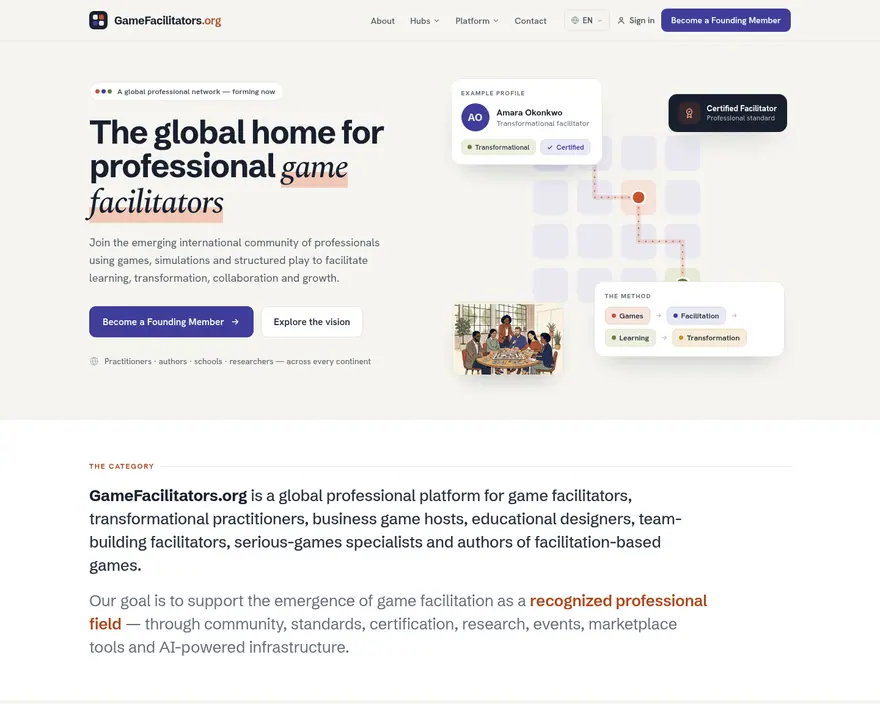
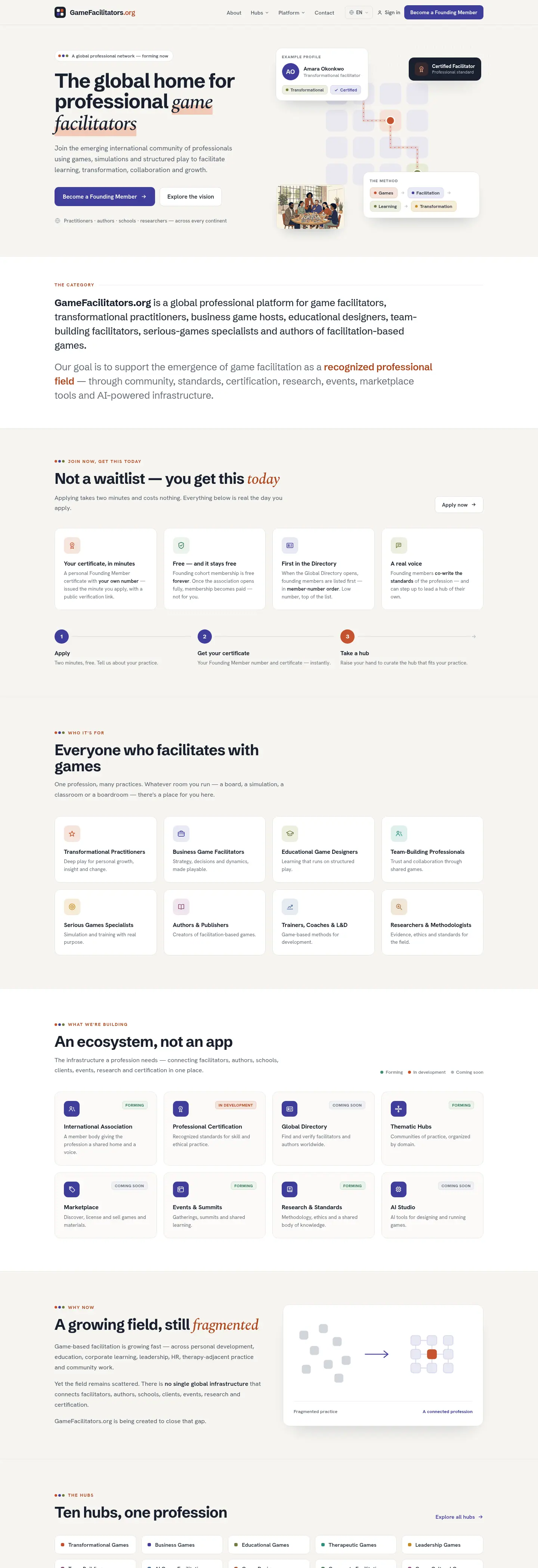
GameFacilitators.org is a Next.js 16 application with a Postgres database through Prisma. The public pages are Home, About, Association, Hubs, Certification, Join and Contact, with news, articles and a privacy page. Every planned part of the platform carries a plain status label. The International Association and the thematic hubs are marked as forming, certification as in development, and the global directory, marketplace and AI studio as coming soon. The Certification page presents its three proposed levels as a draft, open to members.
A founding-member engine
The Join page has three tracks: facilitators, authors and publishers, and schools and organizations. Each track has its own validated form, records which hubs the applicant is interested in, and keeps newsletter consent as a separate choice. The moment an application is saved, the applicant receives a Founding Member certificate with their own number and a public verification link, issued in the same transaction as the application. Confirmation e-mails go out, and every public form sends a copy to the association with a reply-to address set to the sender.
Behind the forms sits an admin view to list, filter and export applications and move them through an audit-logged review.
Hubs and accounts
The Hubs section lists 17 communities of practice, each with its own landing page: practice hubs such as Transformational Games, Business Games, Educational Games, Team Building, AI Game Facilitation and Game Design, regional hubs for Canada, the USA, Ukraine and Brazil, language hubs, and three labs. Interest counts come from the live data. Members sign in with Google or with a link sent by e-mail. An application made before the account existed is linked on the first verified sign-in, together with its certificate and hubs.
Built to grow
Later phases (directory, events, billing, certification, academy, marketplace) are already in the data model and stay switched off behind feature flags until they are ready. Contrast across the site was brought to WCAG AA. Analytics follow an event list defined for the platform: page views and calls to action.
Where it stands today
On 8 November 2026 gamefacilitators.org is live in English, with 30 addresses in its sitemap: the core pages, 17 hub pages, news and articles. The home page invites visitors to become founding members of the 2026 cohort, and the footer carries the Development and promotion credit. The repository history runs from 30 June to 6 November 2026.
Related
The site: corporate websites and educational websites. The field it serves: education. A platform of ours built on the same idea of shared infrastructure: UAFest Network.
Project lead: Marketing MIX. Product: GameFacilitators.org, the platform of the International Association of Game Facilitators. Year: 2026.