


The brief
A song, a dance or a way of weaving often survives with a few elders and is rarely recorded. When it is recorded, the community it belongs to often loses say over where the recording goes. FirstCiv was set up as an archive where communities own what they share, where nothing is published without documented consent, and where that consent can be taken back.
The project needed two things at once. A public site that people want to explore, in several languages, with real pages that search engines and AI assistants can read. And a working intake behind it, where the code itself enforces the consent rules.
What we built
A site generated from its own prototype
FirstCiv started as a design prototype, and the production site is a Next.js 14 application that keeps that design byte for byte. A generator script reads the prototype's sources and emits the data layer, the interactive engine and the styles, so the prototype and the live site never drift apart. To change the design or add a culture, the team edits the prototype and rebuilds.
The prototype was a single-page app whose content appeared only after scripts ran. The production build renders every culture as its own page at a real address, with the full article in the HTML, its own title and description, and structured data, so each page can be indexed. The site runs in four languages, English, Spanish, French and Russian, and its sitemap holds 137 addresses.
Atlas and reference editions
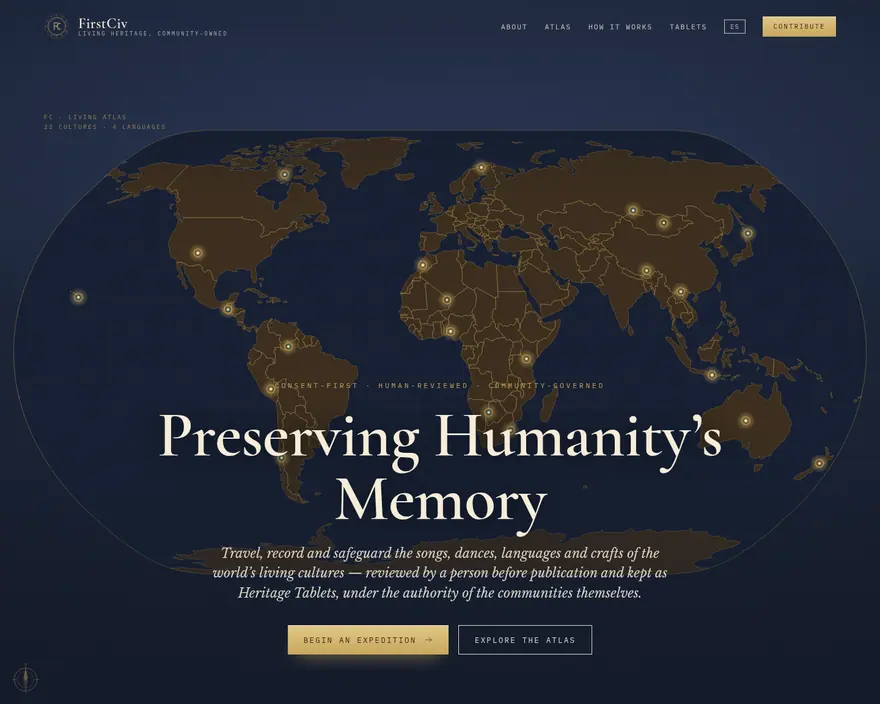
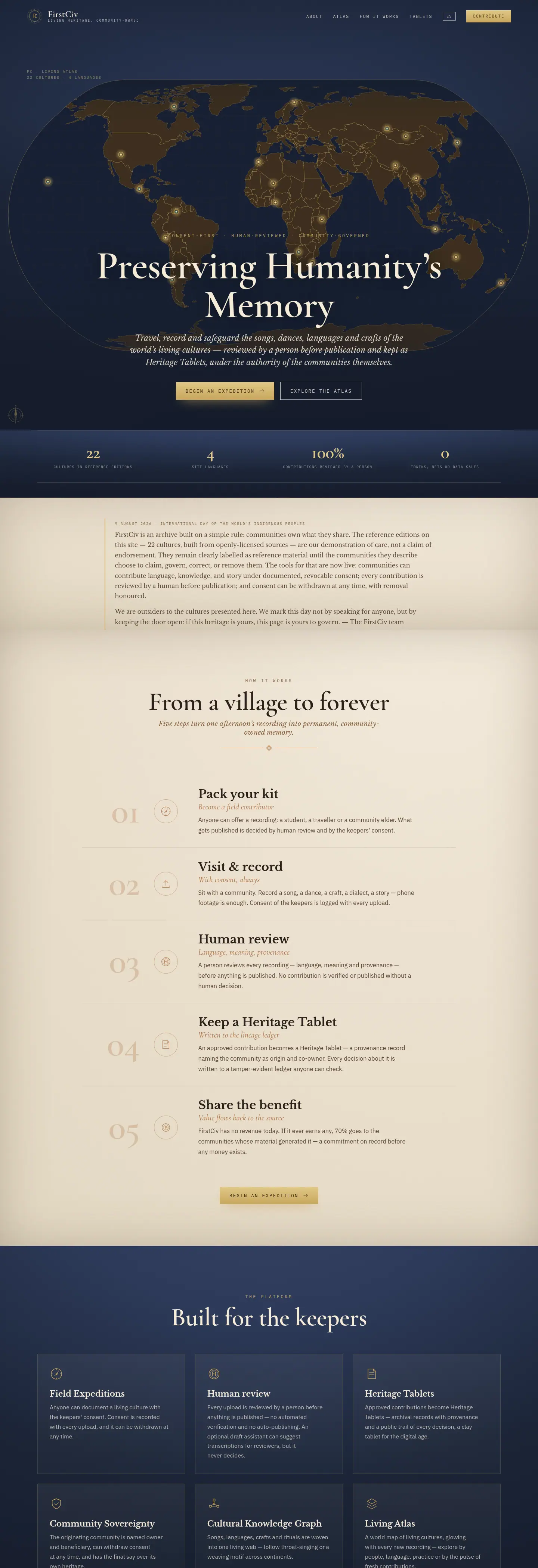
The home page and the Living Atlas show a world map of living cultures that can be explored by people, language and practice, linked by a knowledge graph that follows a practice such as throat singing or a weaving motif across continents. The 22 cultures on the site are reference editions built from openly licensed sources. They are labelled as reference material until the communities they describe choose to claim, correct or remove them, and a page invites communities to claim their entry.
Consent in code
The Contribute form records a song, dance, story, craft or language recording together with a written consent record. Uploads go straight to private storage. A person reviews every submission; nothing is published automatically. An approved contribution becomes a Heritage Tablet, a provenance record naming the community as origin and co-owner. Each consent moves through a defined set of states, every moderation decision is appended to a tamper-evident ledger that anyone can check, and a withdrawal of consent takes the material down. A contact page handles withdrawal requests directly.
Pages for funders and press
Around the archive sit the pages a young project needs: a manifesto, governance and data sovereignty, a page for funders, a press kit, news and a journal.
Where it stands today
On 8 November 2026 firstciv.com is live in English, Spanish, French and Russian with 137 addresses in its sitemap. The home page opens with "Preserving Humanity's Memory", and the footer carries the Development and promotion credit. The production repository's history runs from 6 June to 22 October 2026.
Related
The site: corporate websites. Being read by search engines and assistants: SEO and visibility in AI answers. Another heritage project of ours: BABA & KOKUM.
Project lead: Marketing MIX. Product: FirstCiv, a consent-first archive of living cultures. Year: 2026.