


The brief
FINMOZG is a finance operating system for small and mid-sized companies. It is a product of our business group, and Marketing MIX builds the application and its public site at finmozg.com and promotes them. The site footer carries our credit.
A company of thirty or a hundred people usually runs its finances through a bookkeeper, an outside tax adviser, a payroll specialist and a spreadsheet the owner keeps for cash. Each of them holds part of the picture, and the owner waits days for an answer to a simple question about cash in two months. The brief was one system that does the routine work of each role on one ledger, keeps a person in charge of every filing and payment, and can prove afterwards who did what.
What we built
One ledger, eight engines
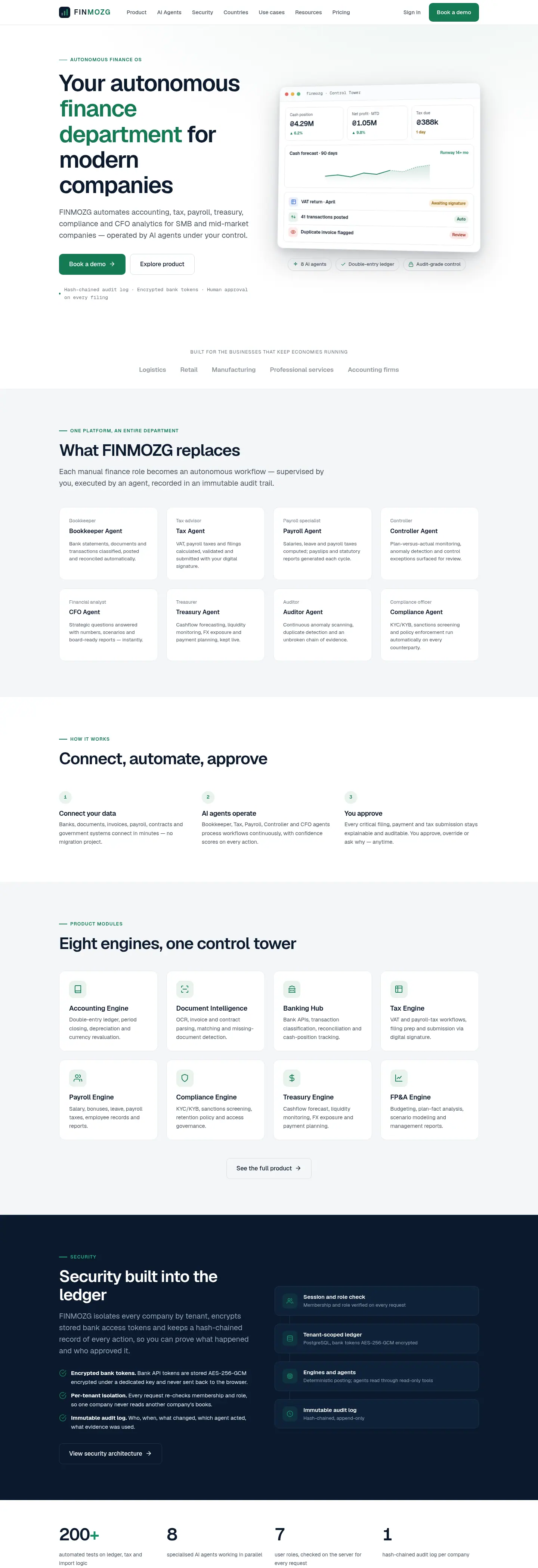
Work started on 29 May 2026. FINMOZG is a Next.js 15 application in TypeScript with PostgreSQL through Prisma and its own sign-in with role-based access. At its core is a double-entry accounting engine. Around it sit eight engines: accounting (period close, depreciation, currency revaluation), document intelligence (invoice and contract parsing, matching, missing documents), a banking hub (classification, reconciliation, cash position), tax, payroll, compliance (KYC and KYB checks, sanctions screening, retention policy), treasury (cash forecast, liquidity, currency exposure) and FP&A (budgets, plan against actual, scenarios).
Agents over deterministic engines
Each finance role has an agent: bookkeeper, tax, payroll, controller, CFO, treasury, auditor and compliance. The agents and a CFO copilot can only read the books through read-only tools over the engines, so the model reasons and explains while every number comes from the ledger. If the AI layer is switched off, the system falls back to deterministic answers and keeps working. Every filing, payment and tax submission waits for a person's approval.
Security in the ledger
Every company is isolated as its own tenant, and every request checks membership and role again on the server; the site lists seven user roles. Bank access tokens are stored encrypted and are never sent back to the browser. Every action goes into an append-only, hash-chained audit log per company: who, when, what changed and which agent acted.
Ukraine first
The first country pack is Ukrainian: sole proprietors and limited companies, VAT, the payroll tax report, personal income tax, the military levy, filing with a qualified electronic signature and the tax calendar. The site shows the government and banking systems the pack is built around and lists five more countries as planned.
A site for buyers and for search
The public site explains the product by role and by module, with pages for each agent, use cases, security and countries. A resources section carries guides, a glossary and comparisons, with sections in English, French and Russian.
Where it stands today
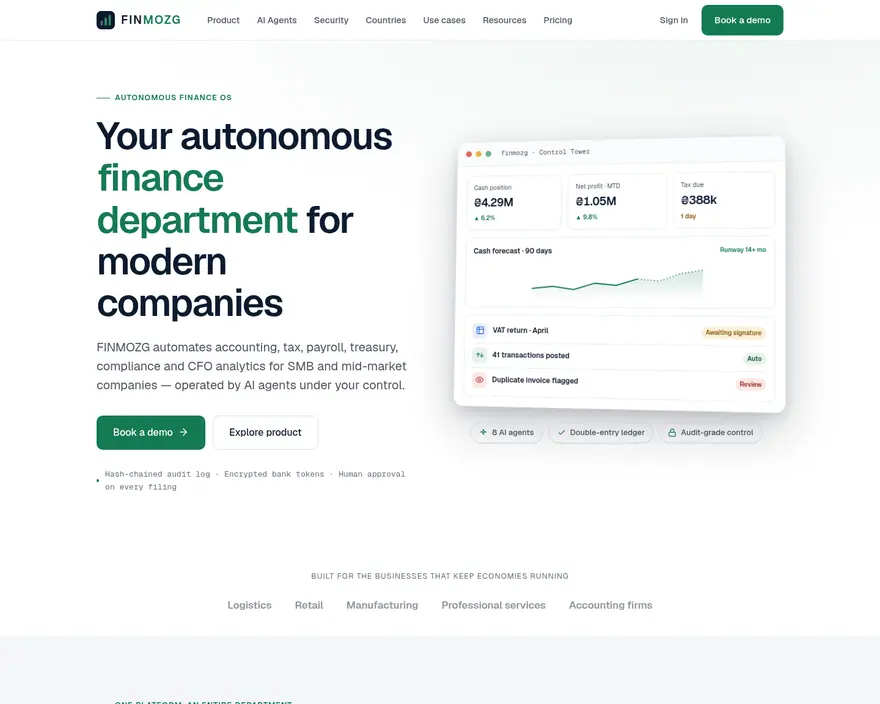
On 8 November 2026 finmozg.com is live. The menu holds Product, AI Agents, Security, Countries, Use cases, Resources, Pricing, Sign in and Book a demo. The home page goes from the roles the system replaces to the three steps (connect, automate, approve), the eight engines, the security model, the Ukrainian stack and sample questions to the CFO agent. The sitemap lists 84 addresses, 54 of them in the resources section.
Related
The site: corporate websites. Search: SEO. Visibility in AI answers: LLM SEO and GEO. The sector: fintech and accounting. Our personal finance app: Finman. The CRM of our group: CRMiUS.
Project lead: Marketing MIX. Product: FINMOZG, a finance system of our business group. Year: 2026.