


The brief
Agintent is a product of the business group Marketing MIX belongs to, so this case describes our own work. The site starts from a familiar problem: a request starts in a chat, gets rebuilt as a prompt, runs in some tool, waits for someone's approval somewhere else and ends as a file in yet another place. By the end, the link between what was asked and what was produced is held together by hand.
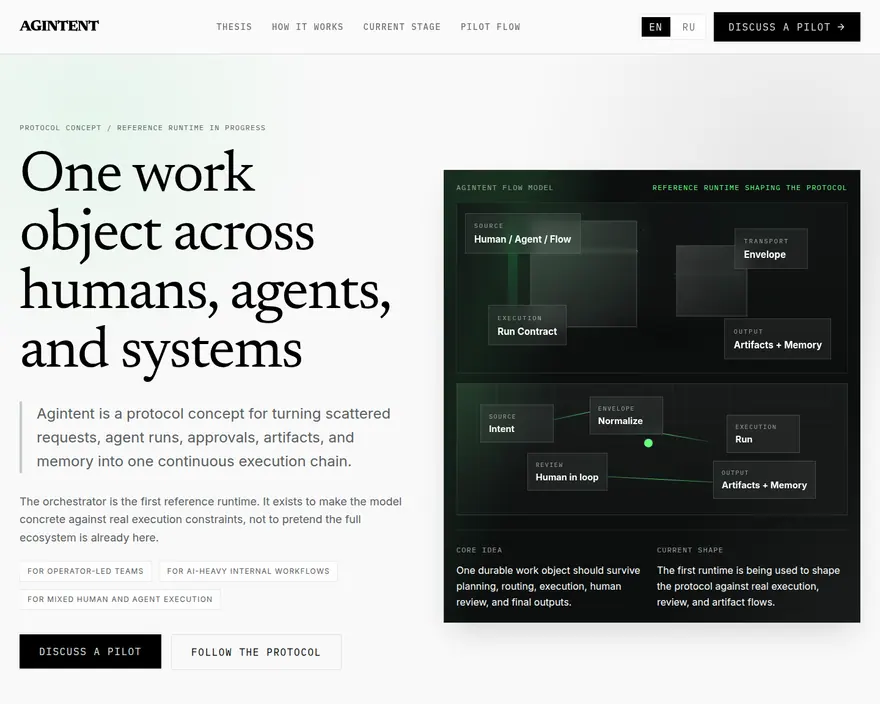
The idea behind Agintent is one durable work object that survives planning, routing, execution, human review and the final result. The protocol comes first. The first application exists to test that idea on real work.
What we built
The protocol vocabulary
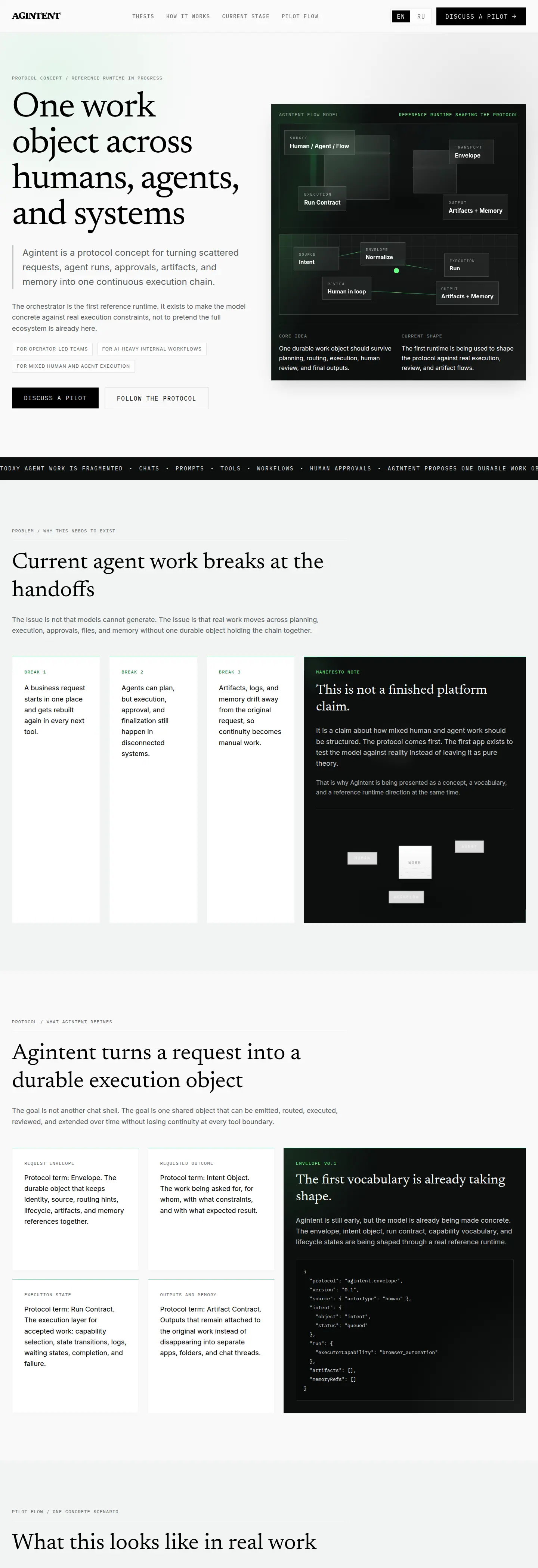
The site defines five terms. The envelope is the durable wrapper: identity, source, routing hints, lifecycle, artifacts and memory references. The intent object is the work being asked for, for whom, with what limits and what expected result. The run contract covers execution: which capability takes the work, its state changes, logs, waiting and completion or failure. An executor capability is a declared surface that can accept or decline an intent. The artifact contract keeps outputs attached to the original request. The home page shows a sample envelope, version 0.1, as JSON.
The reference orchestrator
The first application on the protocol is an orchestrator. It accepts a raw request, normalises it into an envelope, routes the work by executor capability, tracks the run and stores the artifacts for review. A run moves through queued, running, waiting, completed, failed and cancelled states. Human review is one of those states: a run can stop, record why it is waiting, show the exact artifact a person needs to decide on, and then resume, finish or be rejected.
The code was started on 17 April 2026 on Next.js 16 and React 19, with Prisma over PostgreSQL and Redis for the queue. The last commit before this case is dated 28 September 2026.
The public site
agintent.com is a long single page with sections for the thesis, how it works, the current stage and a pilot flow, and a language switch between English and Russian. The pilot flow follows one request: an operator asks for a launch of a new domain and a landing page, an agent turns it into executable work, the run stops for review, and the outputs stay attached to the same chain. The current-stage block lists what exists today and what is still being built: a stronger run contract, better supervision by people, artifact and memory semantics, external emit and consume flows, and production hardening.
Next to the home page there are pages for the protocol, use cases, about and contact, three comparison pages against n8n, LangGraph and Zapier, and a blog with six articles on agent interoperability, among them an explanation of the intent envelope and a comparison of the MCP and A2A protocols.
Where it stands today
On 8 November 2026 agintent.com is live, with 15 addresses in its sitemap and the page switchable between English and Russian. The site presents Agintent as a protocol concept with a reference implementation, open to design partners and pilot conversations, without public sign-up. The footer credits Marketing MIX for development and promotion.
Related
The site: corporate websites. Visibility in AI answers: LLM SEO and GEO. AI systems for a business: AI agency in Ottawa. The sector: B2B SaaS.
Project lead: Marketing MIX. Product: Agintent, a protocol of our business group. Year: 2026.