

The brief
Life Capital is a decision-making simulation: a board game with a ledger per player, played in five-hour sessions by teenagers from 14, adults and company teams. The method was written in Kharkiv in 2017. Its English-language version was brought to Canada by Olga Ialovenko, who runs Life Capital Global from Carleton Place, Ontario, and sessions and tournaments run in English and Ukrainian.
The audience is three kinds of buyer at once: parents and young adults, schools and funders, and companies that book a team session. All three reach the company through Google, through a teacher's recommendation or through a tournament, and all three need an address, a price and a date before they write. The site that had to carry that was an older MODX build. Our audit of 23 July 2026 listed what a first-time visitor and Google both met on its home page: a robots tag saying noindex beside one saying index, an empty meta description, a placeholder phone number, images with the alt text "Image Not Found", a "Test event" in the menu, buttons that went nowhere and sample testimonials copied three times.
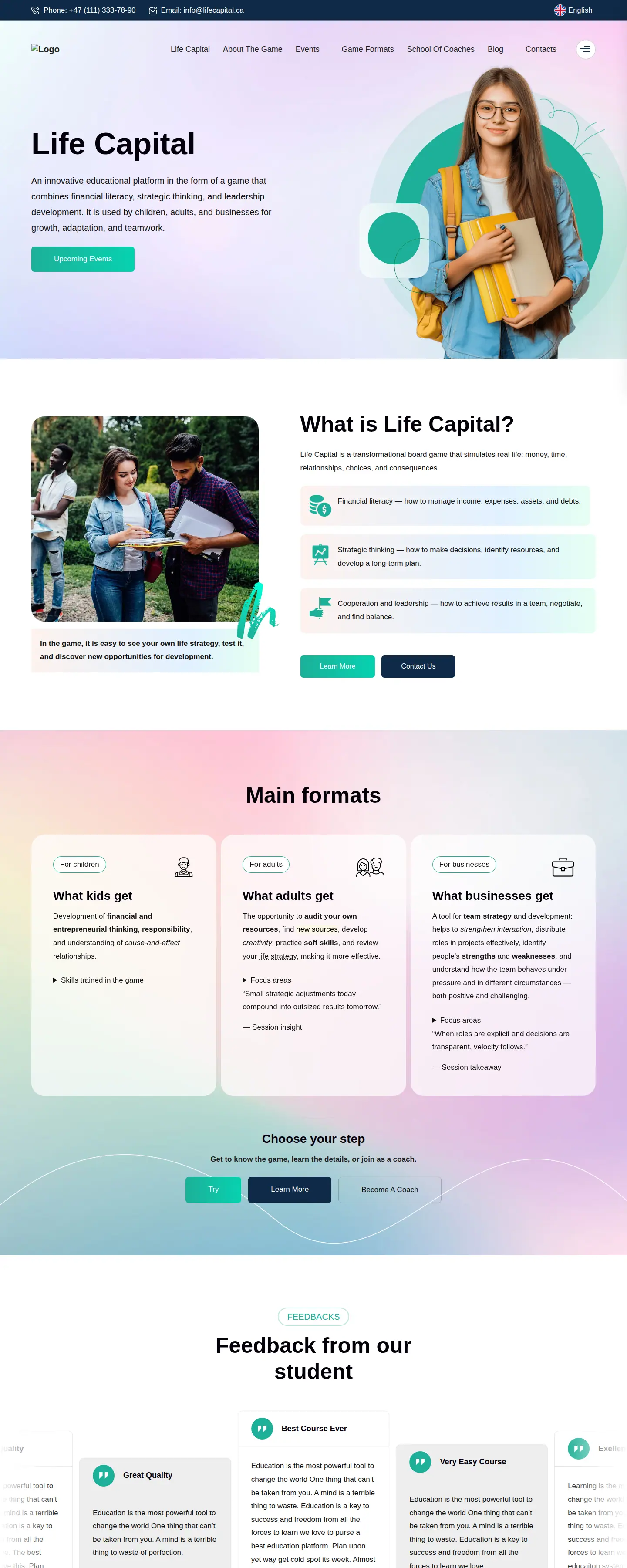
The decision of 23 July was to keep the content and replace everything around it. The domain went to Cloudflare on 24 July 2026, and the first row in Search Console's export is dated 23 July.
What we did
A static site on the owner's domain
The site is a Next.js static export on Cloudflare Pages in three languages: English, Ukrainian and French. On 30 October 2026 its sitemap lists 58 URLs, 27 English, 21 Ukrainian and 10 French. The domain moved to Cloudflare on 24 July with the mail records copied exactly, so the info@ mailbox kept working through the switch.
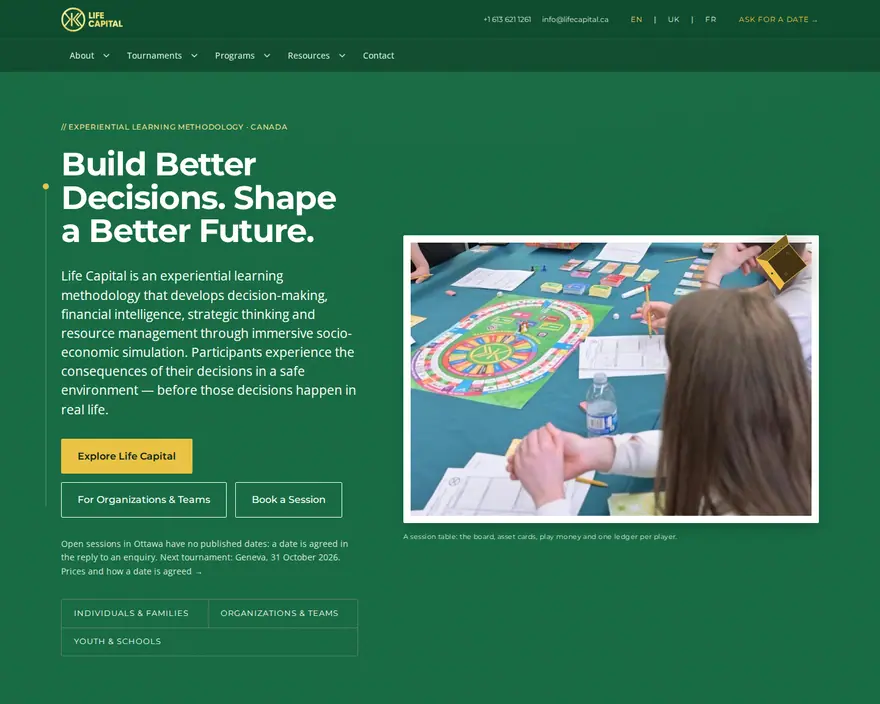
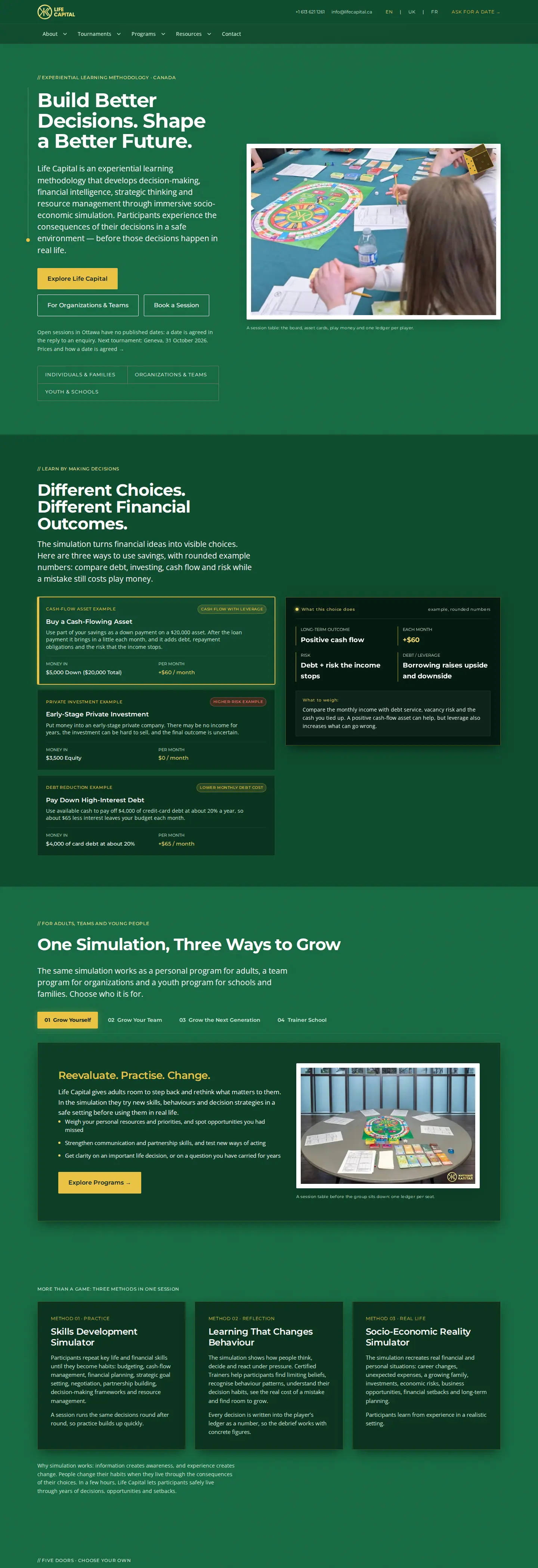
The first release was a one-to-one port, which gave a safe point to start from. The rewrite followed in waves, and a later one replaced the theme with a dark-green design built around the game's cloth and ledger: a new home page with the headline "Build Better Decisions. Shape a Better Future.", three worked savings examples with rounded numbers, a tabbed block for individuals, teams and young people, new Programs and Partner With Us pages, a navigation matched to the team's own structure document, and a footer rebuilt around what each audience looks for.


Claims that have a source
The owner's rule for this site is that a number appears only with a document behind it. A release gate on every build checks for forbidden figures, private Drive links, pending markers and unsupported claims, and the legal facts were checked against registries: the Ontario corporation and the Ukrainian rights holder. Two examples of what the gate removed from the first drafts were a round "160+" for one tournament and "guaranteed" language on the simulator. The Geneva forum page states the organiser's own date, 31 October, where an earlier draft carried a range.
Privacy and consent before analytics
The audience includes teenagers and the forms collect personal data, so the site shipped with privacy pages in all three languages and Google Consent Mode v2. Analytics loads after the visitor accepts, which was checked in a headless browser: no analytics requests before consent, and a granted consent state after it. One consequence shows in the figures below: Google Analytics undercounts visits, and Search Console is the reliable traffic source for this case.
Forms that reach a person
Contact, trainer-school and partner forms post to a worker that stores the enquiry and mails it. From 1 October 2026 the same enquiries are copied into a CRM at a protected address, with roles by direction (tournaments, schools, trainers, partners, support) so each team member sees only theirs. Every enquiry records the page it came from and one line of attribution.
Search and AI-search layer
Every route has its own title and description, hreflang for English, Ukrainian and French is in the head, the sitemap lists the language alternates, and the home page carries Organization and WebSite JSON-LD while articles carry BlogPosting, FAQPage and BreadcrumbList. An llms.txt file describes the organisation for AI assistants. The sitemap was submitted in Search Console on 25 July and resubmitted on 22 September and 22 October.
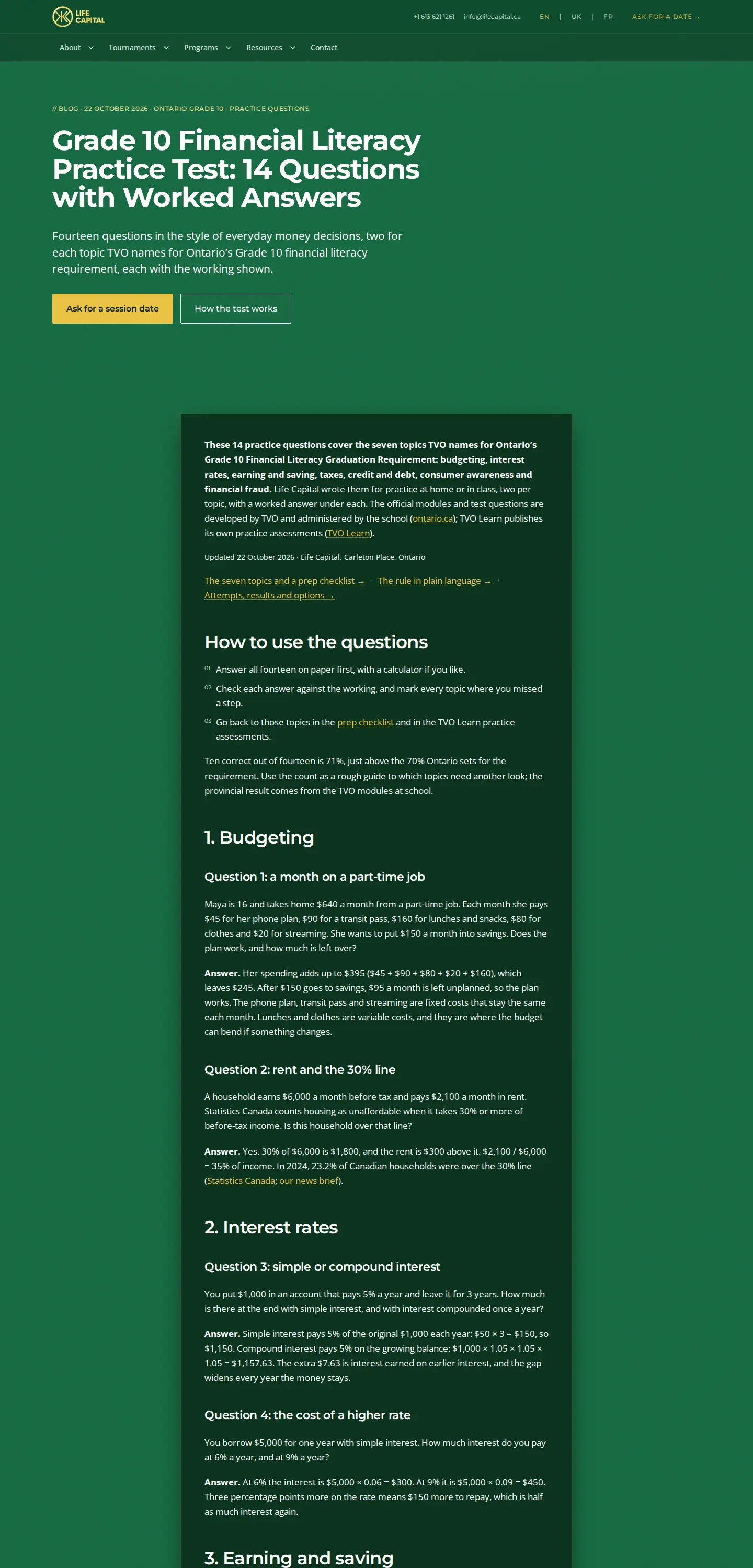
On 22 October the team added a long practice article for Ontario's Grade 10 financial-literacy requirement. It carries fourteen questions with worked answers, two for each of the seven topics TVO names, and links to the Ministry and TVO pages for the official modules instead of copying them. Two other pages already answered the same family of queries: a guide to the graduation requirement and an article on the TVO test.
What happened
Search Console's domain property shows 122 clicks and 4,192 impressions between 23 July and 28 October 2026. Weekly clicks sat at 0 to 7 until the end of September, then stepped up: 16 in the week of 28 September, 11, 13, 28 and 30 (three days) in the weeks after.
Impressions changed earlier and by more. They stayed under 60 a week through August and early September (39 in the week of 7 September) and rose to 260 in the week of 21 September and 1,536 in the week of 28 September. The step follows the 22 September release that cleaned the claims, added the consent layer, renamed the routes and resubmitted the sitemap, and it follows the first Grade 10 pages, whose first impressions are dated 23 September for the graduation-requirement guide and 29 September for the TVO test article. Search Console cannot say which of these moved the numbers, so the case keeps the dates side by side.
Three pages account for most of the October demand. The TVO test article has 19 clicks from 1,472 impressions, the graduation-requirement guide 6 clicks from 1,097, and the practice article 26 clicks from 333 impressions since its first impression on 23 October, at positions between 4 and 6. The brand query "life capital" gave 11 clicks from 85 impressions at an average position of 6.2 (the same 98 days). The home page itself took 30 clicks at an average position of 5.3, and the Ukrainian home page 16. Canada supplied 88 of the 122 clicks and Ukraine 15.
The CRM database holds 16 enquiries from forms between 6 September and 29 October 2026: 7 in the first lead store and 9 in the CRM since it went live on 1 October. By direction there are 6 schools in September and 4 in October, plus partner, trainer and tournament enquiries. A further 27 records are bug reports the founder filed through the site while testing, and are not counted.
What this case leaves out is sessions and bookings. Analytics is consent-gated and the site records enquiries, so the sheet cannot say how many of the 16 became a paid seat or a school club.
What we would do next
Count paid seats. A status for "booked" in the CRM, filled when payment lands, turns 16 enquiries into a cost per seat.
Answer the query that already ranks. The graduation-requirement guide has 1,097 impressions and 6 clicks. A title that names the grade and the test, as the practice article does, is the cheapest next edit.
French pages for Ottawa schools. Only 10 of the 58 URLs are French; the Grade 10 topic has one French page.
More dated session pages. Open sessions in Ottawa have no published dates today; a dated Event page per session would give search a reason to show them.
Related
For the build: corporate website development. For search: SEO promotion and promotion in AI search. Sector page: education. Local context: marketing agency in Ottawa.
Project lead: Marketing MIX. Client: Life Capital Global (lifecapital.ca), Carleton Place, Ontario. Year: 2026.